Why Toyota Chose Delivery Over Volume
Toyota cut overseas production by 100,000 units due to rising logistics risks. Here is a 3-step export marketing strategy to win buyers with reliable delivery times instead of price cuts.
Key takeaways
- As Toyota's 100,000-unit cut proves, the top priority for global buyers today is supply chain stability, not unit price.
- Quantify your actual lead times and map out 2-3 alternative logistics scenarios to use as your core sales pitch.
- Instead of making vague promises, address the buyer's logistics pain points right from the first buyer cold email and seize logistics control through Incoterms negotiation.
Why Toyota Cut Overseas Production by 100k Units: 3-Step Export Marketing Strategy Focuses on Delivery Over Price
In August 2026, global automotive giant Toyota made a shocking decision. It is an event that companies staked on overseas buyer discovery must pay close attention to. Toyota cut its planned overseas production by a staggering 100,000 units through February 2027. Conversely, it announced an increase of 4,200 units in domestic production in Japan (such as the RAV4) (Source: Yahoo! News Business). It was the moment the myth of 'overseas outsourcing'—the belief that cheap foreign labor always guarantees higher margins—was completely shattered.
The reason is clear. As the logistics crisis originating from the Middle East drags on, the opportunity cost of stranded cargo far exceeds the cost savings from overseas manufacturing. This massive shift is directly impacting the export marketing landscape for SMEs as well.
With global supply chains in flux, international buyers are no longer just looking for a 'dollar-cheaper product'; they are desperate for 'products that arrive on time, no matter what.' This period of supply uncertainty is your chance to change the game. Instead of competing in a race to the bottom with price cuts, here is a 3-step guide to changing the rules of export marketing using 'predictable delivery control' as your weapon.
| Step | Objective | Time Required | Key Deliverable |
|---|---|---|---|
| Step 1 | Establish alternative logistics scenarios | 3–5 days | Actual cost & transit time data by route |
| Step 2 | Send delivery-focused cold email | 1–2 days | Personalized pitch addressing buyer pain points |
| Step 3 | Negotiate Incoterms | 1–2 weeks | Contract securing logistics control (CIF/DAP) |
Did you notice something interesting in this table? Winning over a buyer takes far more preparation to ensure 'certainty of arrival' than simply boasting about 'how great our product is.'
Preparation Before You Start
Before launching a delivery-focused strategy, export managers should have these three practical data sets ready on their screens:
- Average lead times & On-Time In-Full (OTIF) rates over the past 6 months: You need cold, hard data, not vague estimates.
- Alternative routing plans: Check immediately if your current freight forwarder has a 'Plan B' ready, such as Cape of Good Hope routing.
- Incoterms in existing contracts: Review the exact delivery terms you have habitually signed off on in the past.
Only when these three datasets are on your desk are you ready. Instead of making empty promises like 'trust us,' you can present verified data to embark on serious overseas buyer discovery.
Step 1: Build Alternative Logistics Scenarios to Prove Lead Time Reduction
Before writing to a buyer, let's analyze exactly when, through which route, and at what cost your cargo will arrive. What buyers fear even more than defective goods is 'blind shipping'—not knowing where on earth their cargo is floating.
Calculating Your Company's True Lead Time
Map out two or three alternative scenarios, such as third-country transshipment or Sea & Air multimodal transport, instead of relying solely on your usual direct routes. Calculate how many extra days each route takes, how much the cost per container will increase, and conversely, where reducing lead times is possible. In practice, freight forwarders are often reluctant to share detailed schedules. In such cases, we recommend using digital logistics platforms to cross-reference real-time quotes and schedules from multiple forwarders.
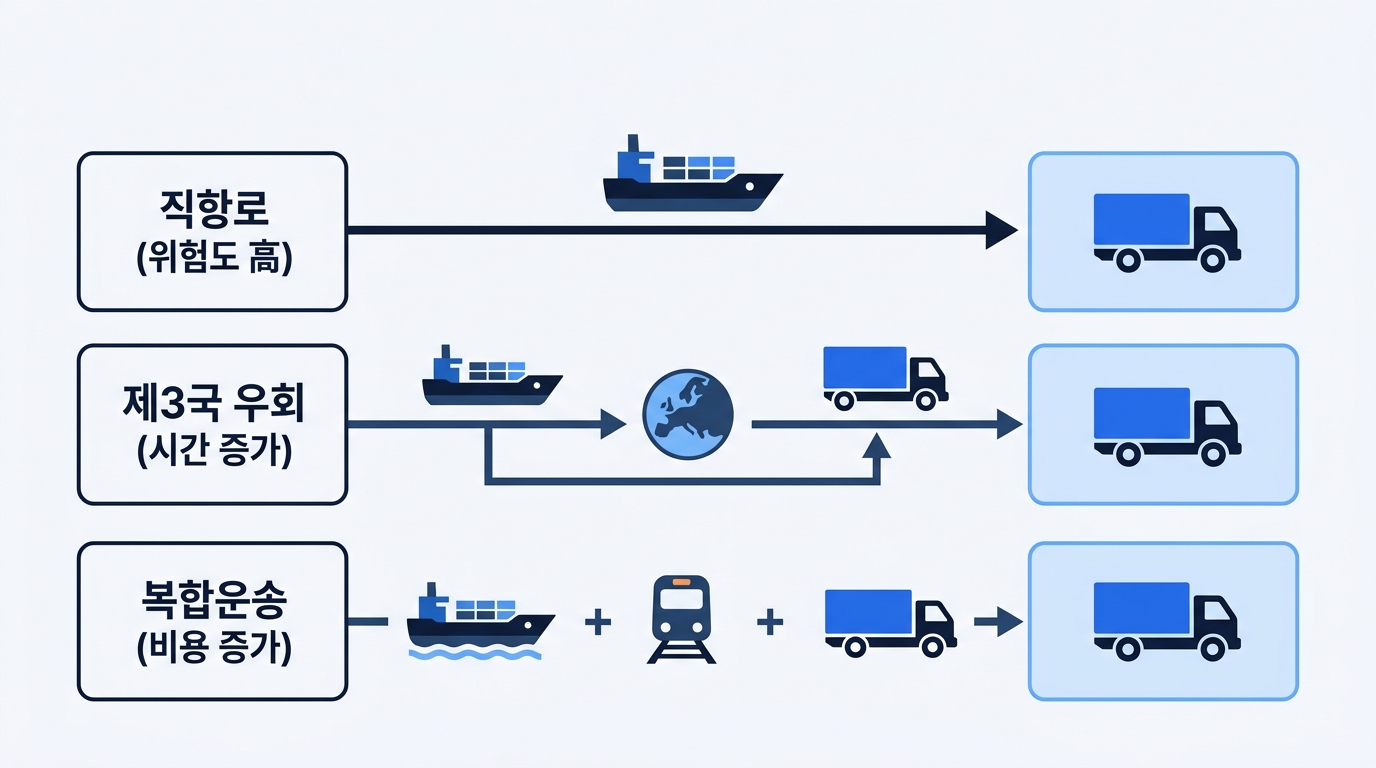
When mapping out scenarios, clearly define the trade-offs between time and cost, as shown in the diagram above. This gives you a powerful bargaining chip during back-and-forth negotiations with the buyer.
Step 2: How to Write Buyer Cold Emails That Boost Response Rates
Now that you have solid logistics data, it is time to write a buyer cold email that will capture the interest of new targets.
Address the Buyer's Logistics Pain Points in the Very First Line
Generic opening lines like "Our products are high quality and cheap" go straight to the trash bin in a second. Instead, target their immediate pain point: "Are you struggling with inventory management due to recent Middle East shipping delays? We secured Route B to guarantee delivery to your Hamburg warehouse within 45 days."
Real-world observations show a stark difference. Companies that send their first follow-up email within 48 hours see significantly higher buyer response rates than those that wait 7 days (though variations exist by industry and season). Buyers burned by logistics risks equate a supplier's rapid feedback with their 'ability to handle logistics crises.' If your email open rates are lagging, try targeting the buyer's specific destination port in the subject line (e.g., "Proposal: Guaranteed On-Time Delivery to Hamburg Port") to drive clicks.
Step 3: Take Charge of Incoterms Negotiation to Gain Logistics Control
Has the buyer finally taken the bait? If so, you must secure logistics control when signing the contract. The true measure of successful export marketing lies in defending terms that work in your favor.
Why You Should Propose CIF or DAP Instead of FOB
Put aside FOB (Free on Board) terms, where you must wait indefinitely for the buyer's designated carrier. Instead, steer the Incoterms negotiation by proactively proposing CIF (Cost, Insurance, and Freight) or DAP (Delivered at Place), which allow you to book the vessel and manage the schedule yourself. Of course, buyers might push back initially as their immediate shipping costs will increase.

This is where the Toyota case study comes in handy. Quantify the massive opportunity costs that forced Toyota to cut 100,000 units of production, and map that risk onto the buyer's own potential factory shutdown. Convince them with objective data that even if freight rates go up slightly, this is the most affordable 'safety insurance' to shield their business from logistics chaos.
Common Roadblocks
When using delivery times as a selling point in export marketing, the biggest hurdle is usually cost.
When Alternative Logistics Costs Leave No Profit Margin
Taking safer, alternative routes can trigger freight rate spikes that squeeze your margins. In this case, leverage government export vouchers or 'international shipping subsidies' to ease the financial burden. At the Incoterms negotiation table, introduce a risk-sharing clause where both parties split any unexpected freight fluctuations by a set ratio. For buyers who fixate solely on slashing unit prices, counter with sharp logic: "Instead of signing a cheap contract and waiting indefinitely for cargo that may never arrive, paying a fair price to receive goods on time is far more profitable for your annual bottom line."
Written by · Rinda Export Sales Research Team (Overseas Buyer Discovery & Export Sales Automation Research Editor)
Based on pipeline data from 200+ Korean exporters using overseas buyer discovery and insights from the Rinda platform, we compile practical strategies and checklists ready for immediate use in export operations.
In an era riddled with logistics risks, a sales manager's day is too short to spend manually drafting tailored pitch messages for every buyer. Why not delegate these tasks to a smart tool? Rinda is a platform that extracts accurate contact details of buyers worldwide to support successful overseas buyer discovery and automatically dispatches buyer cold emails highlighting your strong delivery control. We invite you to eliminate repetitive tasks using the technology of Grinda AI, your reliable global business partner, and focus your energy on structuring winning contracts.
- Rinda: https://rinda.ai/?utm_source=rinda_blog&utm_medium=organic&utm_content=10
- Grinda: https://grinda.ai/?utm_source=rinda_blog&utm_medium=organic&utm_content=10
FAQ
Q. How do we pitch when force majeure makes 100% on-time delivery impossible?
A. Buyers are well aware that physical force majeure events like typhoons or wars cannot be perfectly prevented. Your real sales weapon is a 'transparent communication system' that immediately flags delays and triggers Plan B. Show off your rigorous crisis management process right from the first buyer cold email to establish trust early on.
Q. Can Less-than-Container Load (LCL) exporters still maintain logistics control?
A. Yes, absolutely. Instead of blindly handing cargo over to your usual forwarder, start by comparing the schedules and historical reliability of various consolidators. Factor in the time lost during unloading and sorting at the destination terminal, and provide conservative lead times to steer clear of unnecessary claims.
You don't have to figure export out alone
From finding buyers to closing deals, Rinda is with you. Book a free 30-minute chat to see how we can help.