Why Your 'Polite' Cold Emails to Buyers Get Zero Replies
Did you know that telling buyers 'contact me whenever you're free' actually hurts your response rate? Discover how to boost buyer replies with concrete scheduling techniques and hyper-personalized multi-channel outbound sequence strategies backed by real data.
Key takeaways
- The phrase "feel free to contact me whenever you're free," written out of consideration for the buyer, is actually a fatal mistake that pushes the burden of scheduling onto them.
- Data from the sales publication Sales Gravy (2026) proves this. Ten thoroughly researched, hyper-personalized emails record a far higher response rate than 100 generic template emails sent at random.
- We recommend rewriting your call-to-action to narrow down the choices, such as: "Would Thursday at 10 AM or Friday at 2 PM work better for you?"

"I'm available to meet whenever suits you best." or "Please pick a time that works for you from my calendar link below."
These are incredibly common phrases used when sending initial cold emails to global buyers. While well-intentioned, our data shows that the moment you use these phrases, over 90% of buyers quietly send your email straight to the trash.
Are you frustrated by unresponsive buyers? Surprisingly, because of this single "polite" line, the company profiles and catalogs you spent all night translating are being completely ignored. Wasting a week waiting in vain while losing tens of thousands of dollars in opportunities to competitors is not a mistake to be taken lightly.
When Sourcing Global Buyers, Why Does "At Your Convenience" Exhaust Them?
A Polite Poison That Offloads Decision-Making
We easily mistake passing the ball to the buyer to set the schedule as "polite consideration." But how does it feel from the recipient's perspective? It feels entirely like dumping the tedious task of scheduling onto them.
In fact, according to the 2025 KOTRA Export Trend Report, the volume of B2B inbound inquiries and emails that global buyers must process daily has skyrocketed compared to the previous year. They are suffering from severe cognitive fatigue—essentially, brain exhaustion—amidst an avalanche of information.
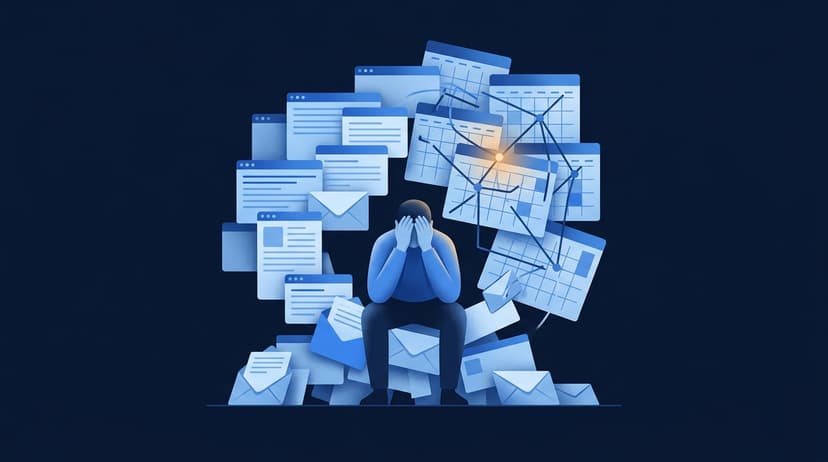
In this state, a buyer absolutely does not want to go through the trouble of reading your email, opening their calendar, finding an open slot, and drafting a reply.
When Scheduling Links (Calendly) Feel Rude
Scheduling tools like Calendly, commonly used in B2B email outbound sales today, are also a double-edged sword. In an initial cold email where trust hasn't been built yet, abruptly saying "Click my link to book a time" can be risky. It might come off as arrogant, implying "You must adapt to my schedule."
Review your company's buyer email templates right now. If a buyer has to think twice just to reply, that email is a complete failure.
The Reply-Getting Formula: Narrow Down the Choices
Thursday at 10 AM vs. Friday at 2 PM
To lower friction and guarantee a reply, you must offer highly specific, narrow options.
For example: "Would a brief 15-minute video call work this Thursday at 10 AM or Friday at 2 PM (EST)?" Sent this way, the buyer can simply reply with a quick, "Thursday works." Removing the friction of decision-making beforehand is the golden rule.
Tailoring Your Pitch to Regional Buyer Cultures
To drive successful export marketing, you must understand the communication preferences of different regions. Even when offering narrowed options, your tone and manner must adapt.
| Region | Buyer Culture & Characteristics | Tips for Proposing Schedules |
|---|---|---|
| North America | Values practicality and speed in decision-making | Specify the local time zone (e.g., EST/PST) and suggest two concrete time options |
| Europe | Requires formality and sufficient pre-meeting info | Clearly state the meeting agenda before proposing specific dates and times |
| Asia | Focuses on relationship-building and flexibility | Avoid major local holidays and offer specific options within a relaxed timeline |
As shown in the table above, the real win in global buyer sourcing lies in how deeply you target details and understand cultural context.
The Difference Between a 1-Second AI Email and a 10-Minute Hyper-Personalized One
The Miracle of a Single LinkedIn Reference
As of 2026, generative AI has democratized mass-mailing, allowing anyone to blast plausible emails in just a single second. However, scraping lists from KOTRA directories or trade show databases to randomly blast generic templates no longer works.
Take a look at Sales Gravy's (2026-07-13) sharp analysis: ten strategically crafted, highly targeted emails yield exponentially better results than 100 thoughtlessly blasted template emails.
Weave a single reference to the buyer's recent LinkedIn post or corporate news naturally into your opening paragraph. This level of hyper-personalization is the only way to instantly close the gap and stand out from the competition.
Human-Centric Sales: Cutting Down on Manual Research
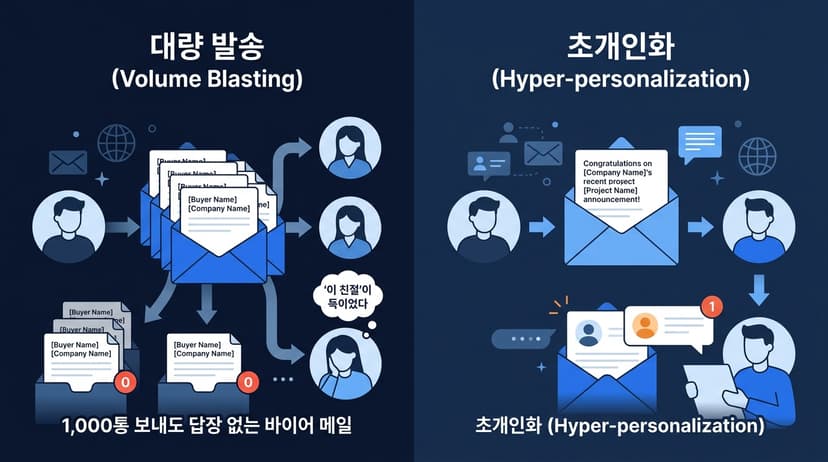
The real constraint, of course, is resource management. For a busy export manager, manually searching and analyzing 100 buyers is incredibly time-consuming. Yet, using automation as an excuse to spam soulless, copy-pasted templates is a recipe for failure.
This is exactly where you should consider adopting smart tools that radically shrink tedious manual research while maintaining a highly human tone of voice.
Breaking Past Email Limits with Multi-Channel Cold Sequences
Integrating Email, LinkedIn, and Voice Messages
To be frank, relying on a single cold email to win over a buyer is a gamble.
Our data shows a fascinating trend: companies that sent their first follow-up within 48 hours of meeting at a global trade show had a significantly higher reply rate than those who waited 7 days. (Of course, the exact impact varies depending on the industry and average transaction size.)
Try sending an email, sending a LinkedIn connection request, and leaving a thoughtful voice message. When these diverse channels work together in an outbound strategy, they build the synergy needed to elicit a real response.
The 7-Day Cold Sequence Blueprint
Here is a 7-day outbound sequence you can implement in your export workflow immediately:
- Day 1: Send a highly personalized initial cold email (including two clear time options).
- Day 3: Visit their LinkedIn profile and send a connection request (briefly mentioning the email you sent).
- Day 5: Leave a meaningful comment on their LinkedIn post.
- Day 7: Send a light follow-up email in the same thread (attaching a new insight or resource).
Before asking for anything, we must provide value first. This is the ultimate weapon for export companies navigating the noise of the generic AI era. Rather than scattering 1,000 mindless template emails, a single, hyper-targeted email that hits the buyer's pain points is what opens their heavily guarded wallets.
Author · Rinda Export Sales Research Team (Global Buyer Sourcing & Export Sales Automation Research Editors)
Based on pipeline data from over 200 Korean export companies and internal observations from the Rinda platform, we curate practical strategies and checklists you can apply to your export operations today.
With Rinda—the AI platform that intelligently automates global buyer sourcing and sales outreach—you can dramatically slash tedious manual research hours.
We also recommend leveraging the robust infrastructure of Grinda AI to build hyper-personalized, multi-channel cold email sequences that reliably win over buyers.
Frequently Asked Questions
Q. Should I attach my company profile and catalog in the first email? A. It is far better to avoid attaching heavy, large files to your very first email. Not only does it trigger spam filters, but buyers are highly unlikely to open unfamiliar files from strangers. Instead, use lightweight cloud links or pique their curiosity by saying, "Let me know if you'd like me to send over our detailed catalog."
Q. How should I propose meeting times with European or North American buyers in different time zones? A. Always propose times in the buyer's local time zone (e.g., EST, CET). Stating only KST forces the buyer to manually calculate the time difference, adding friction. Clearly suggest times like "Wednesday at 10 AM EST" to minimize their decision-making fatigue.
Want export insights in your inbox?
We'll send one email summarizing new posts from our blog and resource library.