Cut Buyer Discovery to 2 Hours Using AI
Still collecting buyer lists in Excel? Modern export marketing is driven by autonomous AI agents that do more than just translate—handling everything from target discovery to personalized emails. Learn how to cut 20 hours of manual labor to just 2 with our 3-step practical guide.
Key takeaways
- Modern export marketing goes beyond simple translation tools like ChatGPT, leveraging AI agents that autonomously orchestrate everything from buyer discovery to personalized cold email outreach.
- Delegating manual buyer listing and outreach drafting to an agent cuts the weekly workflow from 20 hours down to under 2 hours.
- We recommend instantly setting up a workflow by preparing your product's HS Code and English profile, while keeping a human-in-the-loop review process before final delivery.
As an export sales manager handling a packed schedule, are you still manually copying buyer lists from Google search results into Excel? If your use of AI is limited to asking ChatGPT to translate draft emails, it's time to pause and reconsider your approach.
Many of the 200+ export companies we have observed still waste 15 to 20 hours a week on these manual tasks. Meanwhile, the global tech landscape has moved in a completely different direction. We have fully entered the era of 'autonomous AI agents' that make independent decisions, utilize tools, and take action. A clear testament to this is the rise of agentic development environments like OpenChamber, which sparked major discussions in August 2026, gaining 170 points on Hacker News.
The era of static, prompt-and-response text generation is over. The implications for B2B export sales are clear: AI agents can now crawl target buyers' websites to locate the right decision-makers and automatically build hyper-personalized emails tailored to them. 'Autonomous buyer discovery' is officially a reality.
| Category | Legacy Manual Process | Agentic Workflow |
|---|---|---|
| Buyer Discovery | Manual Google search & Excel entry (15 hrs/wk) | Autonomous deep dives across websites in 200+ countries |
| Email Drafting | Simple ChatGPT translation & copy-pasting | Hyper-personalized generation based on recent buyer news |
| Follow-ups | Manual calendar reminders & scheduling | Autonomous follow-ups triggered by open and click behavior |
| Expected Outcome | Dozens of hours wasted each month | Reclaimed time to focus on high-value strategic planning |
The core takeaway from this comparison is simple: AI agents are not here to replace human jobs. Instead, they empower you to focus entirely on what matters most—strategic decision-making.
Prerequisites Before You Start
Before deploying AI agents into your sales pipeline, make sure you have these three elements ready:
- Accurate Target HS Codes and English Profiles: AI agents need a clear compass to navigate. We recommend preparing your exact Harmonized System (HS) Codes along with refined English company profiles and product catalogs.
- Secure Export Marketing Budget: If you are based in South Korea, review the government's Export Voucher Program. Eligible companies can significantly reduce their software costs by choosing verified SaaS solutions from designated Export Voucher providers.
- Human-in-the-Loop Review Rules: No matter how capable an agent is, outbound emails represent your brand. Establish a strict internal policy where a human representative must approve and trigger the final send.
Step 1: Delegate the Complex Task of Finding Foreign Buyers to AI
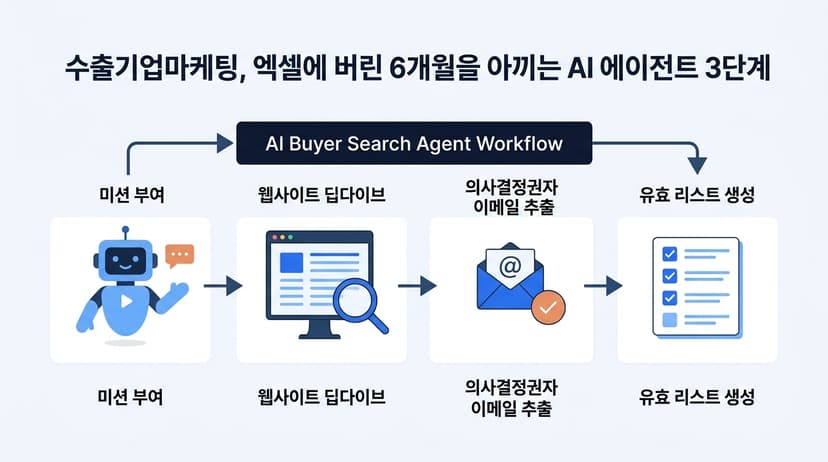
In the past, marketers scrambled to fill Excel sheets by scraping trade databases or exhibition directories. Today, the workflow has evolved to providing AI agents with highly targeted instructions.
For instance, you can assign a mission: "List North American buyers that announced new projects related to [Specific HS Code] in the last six months, and extract the emails of key decision-makers." The agent then autonomously scans hundreds of corporate websites to deliver qualified, high-value leads.
Looking at internal data from the Rinda platform reveals an interesting trend: Korean export companies that maintain multilingual content in English, Japanese, and Chinese on their websites show a much more balanced global distribution of organic search traffic compared to those with Korean-only sites. When agents search and match global data, having multilingual touchpoints on your side creates immense synergy (though individual results can vary based on translation quality and domain authority).
Step 2: Generate Tailored Pitches Autonomously for Successful Sourcing
Once target buyers are identified, the next step is persuasion. Generic copy-and-paste emails that only swap out names while listing raw product benefits are bound to end up directly in the spam folder.
Autonomous agents aggregate the target company's latest news, LinkedIn updates, and regional trends to build hyper-personalized messages. It allows you to pitch highly contextual offers, such as: "We were impressed by your company's recent ESG announcement last month. Our eco-friendly manufacturing process can serve as a key asset in meeting those goals." This represents a paradigm shift in cold outreach automation.
According to a report by elec4 on April 20, 2026, this trend is closer than you think. Grinda AI participated in the World IT Show 2026, successfully demonstrating the Rinda platform. They proved a solution capable of sourcing global buyers across 200+ countries and sending automated, tailored sales emails in over 17 languages. Technology that captures complex business contexts beyond simple translation is already here in the real world.
Step 3: Deliver Without Getting Filtered as Spam and Track Performance
No matter how compelling your pitch is, it is useless if it never lands in the recipient's inbox. Blasting mass emails in a short span can easily ruin your domain reputation and land you on spam blocklists. Therefore, utilizing a cold outreach system that throttles sending intervals and intelligently avoids spam trigger words in an isolated environment is absolutely essential.
Once emails are sent, meticulous tracking must follow. The agent monitors whether buyers open the emails or click the links in real-time, autonomously triggering appropriate follow-ups based on their reactions.
When we analyzed the performance of Rinda's partner companies at global trade shows, we found that buyers who engaged in deep discussions for over 30 minutes had a significantly higher follow-up reply rate compared to those who only briefly exchanged business cards. The online cold outreach ecosystem operates on the exact same principle. The key to boosting conversion rates is setting your agent to trigger immediate, highly relevant follow-up pitches to buyers who show initial engagement by clicking links in your first email (though variations occur depending on the specific trade show and industry).
Common Pitfalls
There are two main pitfalls companies face when adopting AI agents in real-world environments:
First, there are major errors caused by 'hallucination.' If an AI makes up false facts and sends them to a buyer, your hard-earned brand credibility will plummet. To mitigate this risk, avoid giving the agent 100% autopilot control. Always build a safety net where drafts appear on an operator's dashboard and are only sent once the user clicks the approve button.
Second, there is 'developer-centric UI/UX.' If running an agent requires complex coding or infrastructure configuration, sales representatives will quickly burn out. To ensure successful adoption, choose a seamless B2B SaaS platform where managers can intuitively review leads and approve outbound emails with just a few clicks, managing everything from buyer discovery to delivery.

Written by Rinda Export Sales Research Team (Research Editors for Buyer Discovery and AI Sales Automation)
Based on pipeline data from over 200 Korean exporters and direct observations within the Rinda platform, we compile actionable strategies and checklists for export professionals.
If you are wasting dozens of hours every week compiling buyer lists on Excel, it is time to overhaul your outdated workflow. According to reports from beSUCCESS and StartupN on January 6, 2026, Grinda AI's 'Rinda 2.0' automates the entire sales process—from qualifying potential buyers to sending tailored proposals—just by entering a company's website URL. If you want to transform your sales resources, explore sharper insights on Rinda or Grinda AI, the AI platform automating buyer discovery and sales for export companies.
FAQ
Q. How is this different from existing CRMs or mass email tools? A. Traditional tools are mere delivery mechanisms where users manually upload target lists and broadcast the exact same templates. In contrast, AI agents analyze buyer websites to identify the right point of contact, research recent news contexts, and autonomously draft hyper-personalized proposals.
Q. Can early-stage exporters or lean startups use it? A. Absolutely. It is an even more powerful asset for solopreneurs or small export sales teams. The agent takes over tedious, repetitive tasks like lead sourcing and multilingual email drafting, allowing lean teams to scale their global outreach across dozens of countries simultaneously.
Q. I saw limitations on purchasing solutions with South Korea's government export vouchers. Can this be covered? A. First, verify if the solution provider is officially registered as a supplier for the Export Voucher Program. If they are a verified provider, you can leverage your allocated budget to significantly reduce costs and deploy the SaaS solution immediately.
Want export insights in your inbox?
We'll send one email summarizing new posts from our blog and resource library.