Why 95 out of 100 Business Cards from Expensive Tradeshows End Up in Spam
Discover why 95 out of 100 business cards from expensive overseas tradeshows end up marked as spam, and why digital outbound sales outperforms passive booths.

Why 95 out of 100 Business Cards from Expensive Tradeshows End Up in Spam
Does this scene sound familiar? You just spent $25,000 on an overseas tradeshow booth. Back at the office, the export manager's desk is piled high with over 100 business cards. Thinking, "Surely one of these will work out," they spend a whole week researching cold email tactics and sending out messages—only to face devastating results. 95 emails land straight in the spam folder or meet a cold, silent wall.
Why is this? The real reason your cold email response rate is rock bottom isn't the "message." It's that your entire "list-building process" was flawed from the start.
Offline international tradeshows are not magic channels for finding new buyers. Instead, they are closer to "relationship management events" designed to meet existing leads face-to-face and seal final contracts. If you don't accept this painful truth, your precious export marketing budget will continue to drain away into a bottomless pit.
Why Are Expensive Exhibition Booths Inefficient for Finding International Buyers?
According to the 2025 'SME Export Marketing Channel ROI Analysis' by KOTRA, the reality is even harsher. The performance of sourcing new buyers through offline exhibitions was remarkably low compared to the costs invested.
Japanese global expansion consulting firm 'Committers' analyzed real-world data from local SMEs and reached the exact same conclusion (Source: note.jp). They flatly assert that relying heavily on overseas tradeshows to source new partners offers the lowest ROI, pointing out that expensive booth fees are essentially just "existing partner management costs."
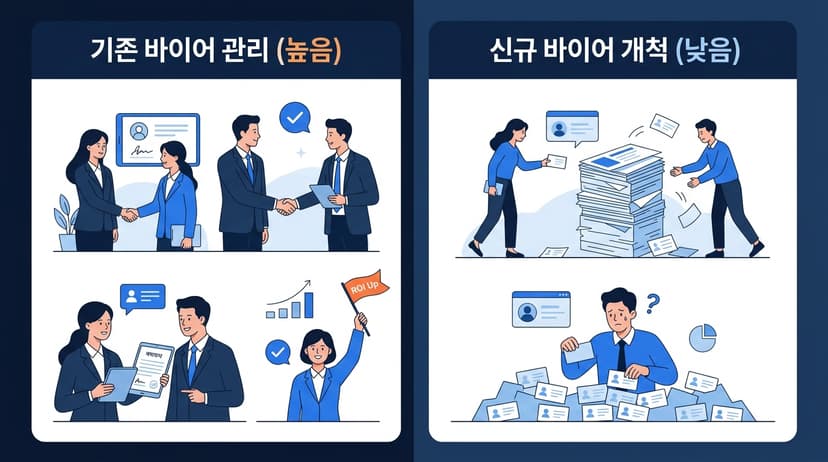
The Structural Limits: Why 95 out of 100 Business Cards Go Straight to Spam
Think about those business cards you exchanged with a smile amidst a crowded exhibition hall. These contacts are not targeted, high-fit leads ready to import your product right away. The pile is indiscriminately mixed with competitors checking out trends, general industry workers, and even casual visitors just looking for free souvenirs.
Our on-site observations revealed an interesting pattern. The cold email response rate was visibly higher for buyers with whom we had deep technical discussions for 30 minutes or more inside the booth, compared to those with whom we merely swapped a business card or brochure. (Of course, results vary depending on exhibition scale and industry decision-making cycles.) In other words, a stack of business cards collected without sharp targeting is nothing more than "dirty data" that needs to be filtered out from a digital outbound sales perspective.
Why Blind List Building and Outsourcing Export Marketing Fails
"Then what if we get a bulk list of buyers from government support programs or external agencies instead of exhibitions?" You’ve probably had this thought at least once.
However, looking at the 2026 trade practice data from the Korea International Trade Association (KITA), the reality is bleak. Mass lists acquired through simple outsourcing suffer from severe error rates. Over half of the contacts are either emails of employees who have already left the company, or generic inboxes (such as Info@ or Sales@) where incoming cold emails are automatically filtered out or ignored.
How Low-Quality Lists Burn Your Team's Precious Time
Agencies often hand over raw lists just to fulfill their contract quotas. The problem is that the grueling task of filtering through this low-quality data falls entirely on your export managers, leading to endless hours of overtime.
Furthermore, outsourcing 100% of your outbound sales drastically increases your failure rate. The people who understand your product's subtle technical advantages and price negotiation limits best are always your in-house team. While you can systemize the initial targeting and outreach process, we highly recommend keeping technical negotiations and closing under direct in-house control. Only then can you achieve true, end-to-end export marketing automation.
Transitioning from Passive Waiting to 'Digital Outbound'
Now is the time to escape the passive trap of waiting at your booth for prospects to wander by. Instead, laser-focus on your target buyers. We suggest building a 'digital outbound sales' pipeline to reach out to multiple target countries simultaneously and instantly track real-world reactions (such as email open rates and meeting acceptances).
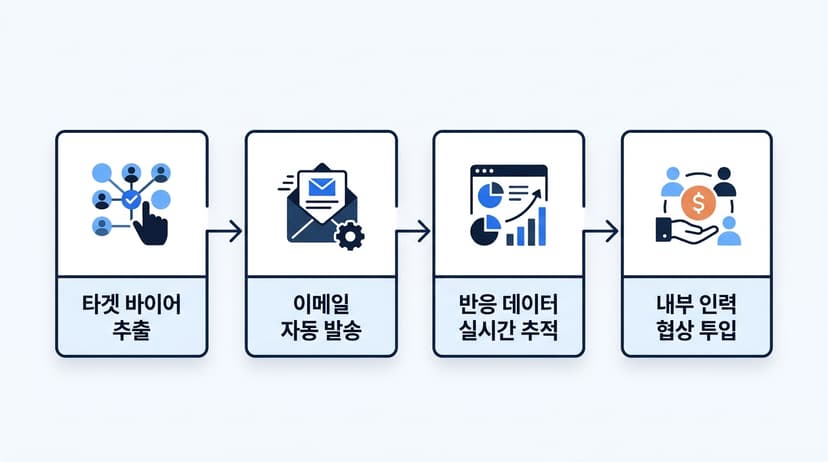
A Pipeline to Track Buyers' Real-Time Response Data
When looking at internal data from the Rinda platform, we see a highly interesting pattern. Teams that sent their first follow-up email within 48 hours after an exhibition ended achieved overwhelmingly higher response rates than those who waited 7 days. (Of course, in industries with longer purchasing cycles, this gap might be slightly narrower.)
The problem is that trying to manually capture this golden window for every single contact is incredibly overwhelming. This is where a hybrid strategy powered by smart digital tools truly shines.
Let's look at the case of Company 'I', a Korean manufacturer of natural cooling hanji (Korean paper) bedding featured on the Rinda landing page. Company I stopped collecting meaningless business cards and started sending highly targeted emails instead. Immediately after sending, responses flooded in, and they successfully booked virtual meetings with international buyers in just 7 days. As a result, they are currently in detailed discussions with 'Halcyondream', a premium Australian brand, regarding sample testing and supply specifications. Moreover, they successfully secured a contract to launch in Robinsons, Singapore's iconic luxury department store. (Please note that the 7-day timeline may vary depending on individual product competitiveness.)
A Practical Checklist for Export Managers
This coming Monday morning, open up Excel and list the business cards scattered across your desk or the lists you received from agencies. We recommend applying the 3-step verification filter below. Simply filtering out low-quality contacts can dramatically cut your pipeline validation time in half.
[Action Item] The First Step in Cold Email Strategy: 3-Step List Verification Guide
- Verify the Actual Decision-Maker: Open up professional networks like LinkedIn. Double-check if the contact still works at the company and actually holds purchasing authority (e.g., Buyer, Sourcing Manager, Category Manager).
- Cross-Check Recent Import History (Within 1 Year): Don't be fooled by fancy distributor websites. We highly recommend verifying whether they have actually imported products matching your HS Code within the past year.
- Exclude Generic Email Accounts: Move generic inboxes starting with Info@ or Sales@ to the bottom of your list (or discard them entirely). You must find the personal company email of a specific decision-maker (e.g., [email protected]) to significantly boost your cold email response rate.
Automate Sourcing and Outreach, Leave Negotiation to Humans
To drive global expansion with limited resources, a clear division of labor is vital. Hand over the tedious work of building lists and sending initial intros to a system.
Instead, export managers should direct 100% of their energy toward pricing negotiations and virtual meetings with the "real buyers" who reply. That is where real sales happens.
Written by · Rinda Export Sales Research Team (Sourcing & Export Sales Automation Research Editors)
We compile immediately actionable strategies and checklists for export professionals, based on data from 200+ Korean exporting companies' pipelines and direct observations within the Rinda platform.
Stop spending your export managers' precious time on passive buyer matching or offline overseas exhibitions. Discover how Rinda, the AI platform designed to help exporters find international buyers and automate sales, can dramatically shorten your early-stage sales pipeline and market validation cycle.
- Rinda (International Buyer Database & Cold Email Automation)
- Grinda AI (AI Export Automation & Company Intro)
Frequently Asked Questions (FAQ)
Q. Should we avoid using buyer lists provided by KOTRA support programs entirely? A. Not at all. However, instead of blindly trusting the list, treat it as an "initial hypothesis." To avoid wasting precious time, rigorously filter the contacts using the 3-step checklist (LinkedIn verification, recent import history, and excluding generic emails) before launching digital outbound campaigns to the verified targets.
Q. Does this mean we shouldn't participate in tradeshows at all? A. No, not at all. It means you should pivot the primary purpose of exhibitions from "sourcing new leads" to "verification and closing." Try inviting targeted buyers—whom you've pre-warmed via digital outbound—to your booth. Using the tradeshow as an "offline showroom" to let them handle physical samples and sign final contracts is the absolute best way to maximize your ROI.
Sources
Want export insights in your inbox?
We'll send one email summarizing new posts from our blog and resource library.