Why 62% Regret Collecting Expo Cards
In an era where small indie brands account for 68.7% of beauty exports, many companies still spend tens of thousands of dollars relying on offline trade shows—only for 62% to be disappointed by low conversion rates. With 70% of B2B buyers making decisions before they ever meet a sales rep, we share an AI outbound automation strategy to enter the digital shortlist and triple your meetings.
Why 62% of Exhibitors Regret Gathering 1,000 Business Cards
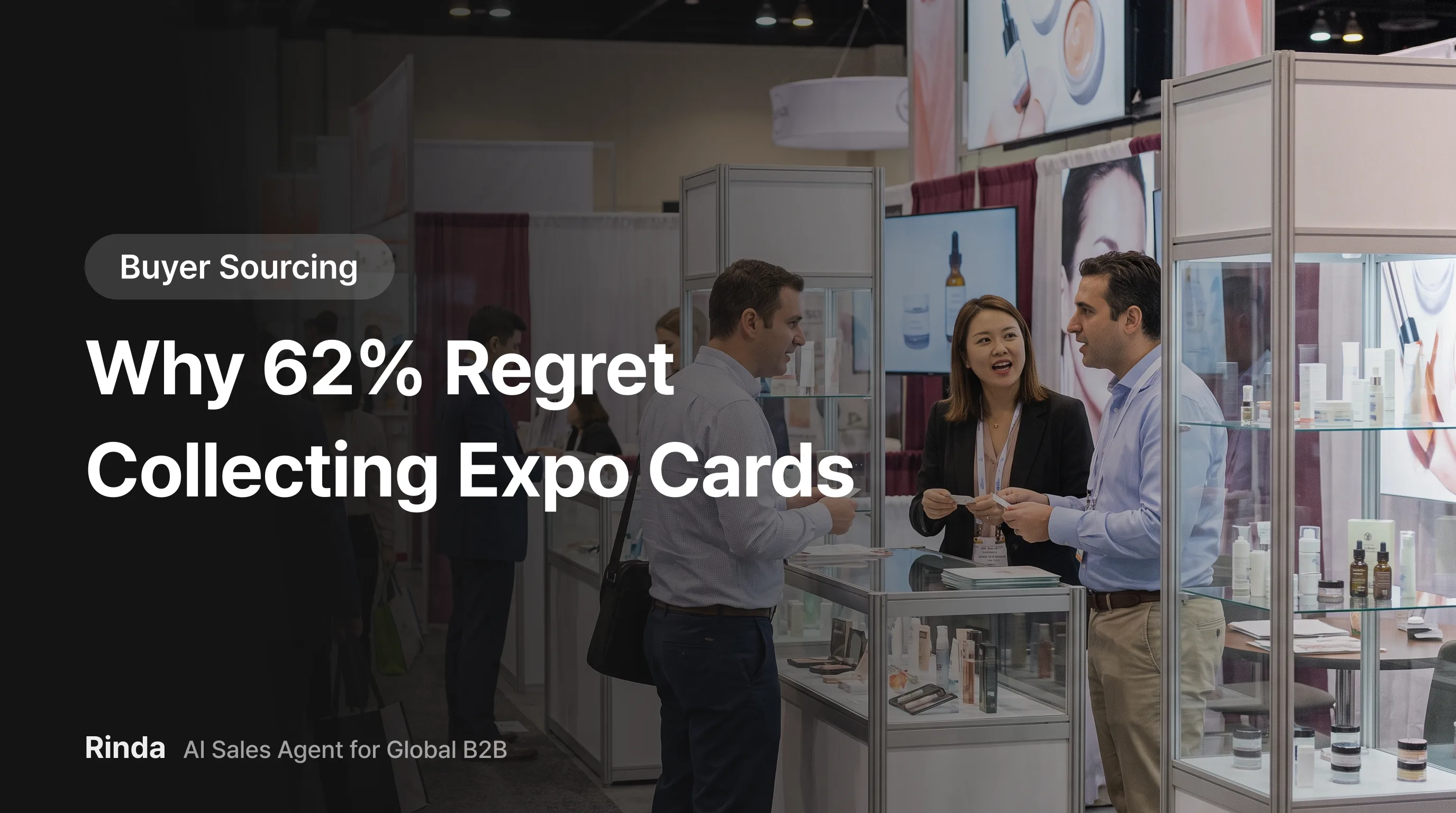
You spend tens of thousands of dollars setting up a flashy booth at an international trade show. You stand on your feet for three days and collect 1,000 business cards. Yet six months later, not a single one has turned into an actual B2B export contract.
This reveals the most common and painful misconception early-stage exporters face during buyer discovery. Is the firm belief that exports only happen when you meet people face-to-face offline still valid today?
The Rise of Indie Brands: Accounting for 68.7% of Total B2B Exports
Let's look at the data first. In 2025, South Korea's cosmetics export volume hit an all-time high of $11.43 billion, up 12.3% year-over-year. The most notable point here is that the US ($2.2 billion) has firmly established itself as the largest export destination, overtaking China, the long-standing number one (Source: Issue Insight, based on Ministry of Food and Drug Safety and Korea Customs Service data).
There is an even more surprising metric. As of the first half of 2024, small and mid-sized 'indie brands' accounted for a staggering 68.7% of total cosmetics exports (Source: Issue Insight, citing the Ministry of SMEs and Startups). The old formula that B2B export is exclusive to large conglomerates with massive capital and dedicated global sales teams has long been shattered.
This trend becomes clear when looking at the global success stories featured on Rinda's beauty industry page. Think of d'Alba, which took the #1 spot for face mists on Amazon, or ANUA, which entered 1,400 Ulta stores purely through TikTok virality. They didn't push through with massive capital; they pierced market niches with razor-sharp targeting. Even founders of early-stage brands or solo practitioners can wide-open the doors to the global market if they point themselves in the right direction.
Why Do 62% of Exhibitors Walk Away Disappointed with Offline Buyer Discovery?
Yet, on-the-ground export marketing strategies still follow outdated playbooks. To penetrate the US or European markets, many companies start by burning tens of thousands of dollars to book exhibition booths.
The reality is quite cold. According to the 2025 Korea International Trade Association (KITA) Export Company Survey (cited from Grinda AI's internal comparative analysis report), about 62% of companies participating in offline overseas exhibitions admitted that the actual contract conversion rate compared to the cost invested fell far short of expectations.
Why is this? It's not because they didn't collect enough business cards. In fact, 80% of the people met at exhibitions are junior staff or simple attendees. Even if you diligently send cold emails after returning home, they bypass the decision-making directors entirely and go straight to the spam folder. We call this phenomenon the 'Buyer Discovery Gap.' It is the paradoxical situation where a company pours massive budgets into offline trade show marketing, yet fails to appear on the screens of actual decision-makers.

We recommend objectively diagnosing whether your company's current sales methodology is trapped in this vast Buyer Discovery Gap.
How to Make It onto the 'Digital Shortlist' Instead of the Offline Booth
The reason we must fundamentally flip the paradigm of buyer discovery is that buyer behavior itself has transformed.
The Gartner 2025 B2B Buyer Behavior Survey points directly to this change. Around 70% of B2B buyer purchasing decisions are completed before they ever shake hands with a sales representative. They proactively search for information through digital channels and complete their evaluation of the shortlist.
Global retail buyers and distributors no longer wander around Cosmoprof exhibition halls all day looking for new brands. They sit at their comfortable office desks, search LinkedIn, and filter suppliers by keywords and HS codes on sourcing platforms. While you are sweating and handing out business cards to passersby in front of your booth, the decision-makers with real authority have already shortlisted and reviewed their brands of interest online.
In the end, the battlefield of outbound sales has completely shifted away from offline events. It's now about appearing precisely within the target buyer's digital field of vision at the exact moment they are contemplating sourcing.
Stop Manual Searching: Adopt Sales Automation to Speed Up Buyer Responses by 10x
For early-stage exporters lacking immediate manpower, the only breakthrough to keep up with this massive digital journey is sales automation. Instead of wasting precious time manually scouring Google and trade center directories, you must let a system automatically find and verify targets.
This is not a vague claim; the numbers prove it. According to Zipteams' 'Top AI Sales Rep Tools 2026 Guide' (citing HubSpot 2025 data), B2B companies that adopted AI sales agents saw a 3x surge in qualified sales meetings booked. Even more impressively, prospect response times were slashed by more than 10x.
From our own observations, a 3-person beauty exporter based in Busan stopped manual searching and adopted automated buyer discovery; within just 60 days, they increased their qualified buyer responses from 2 to 11. The secret was surprisingly simple. They accurately secured the real email addresses of active decision-makers and launched an optimized cold email sequence that bypassed spam filters. Consequently, they reallocated the time previously wasted on sorting business cards and manual mailing into video meetings to negotiate actual contracts.
Author · Rinda Export Sales Research Team (Buyer Discovery & Export Sales Automation Research Editors)
Based on the buyer discovery pipeline data of 200+ Korean exporters and internal observations of the Rinda platform, we compile immediately actionable strategies and checklists for export practitioners.
Instead of spending tens of thousands of dollars on a trade show booth that lasts only a few days, we invite you to begin risk-free, genuine buyer discovery through a data-proven export automation platform. Rinda (https://rinda.ai/?utm_source=rinda_blog&utm_medium=organic), the AI platform that automates buyer discovery and sales for exporters, powered by Grinda AI (https://grinda.ai/?utm_source=grinda_blog&utm_medium=organic), will become your reliable new pipeline.
Frequently Asked Questions (FAQ)
Q. We are an early-stage exporter. Does this mean we shouldn't participate in exhibitions at all? Not at all. Trade shows remain an excellent weapon for raising brand awareness and strengthening relationships with existing clients. However, relying on exhibitions as your sole lifeline for finding new buyers and sinking your entire budget there is highly risky. If you leverage outbound sales automation to pre-book meetings before stepping onto the exhibition floor, you can maximize your ROI to its limits.
Q. What is the key to cold emails that don't end up in the spam folder? It lies in sophisticated targeting and personalization that hits the right 'Buyer Fit'. Mass-blasting generic company introductions filled only with self-praise will result in 100% spam categorization. Instead, address the recipient's recent business trends or painful pain points directly in the very first line. This is the ultimate key that makes a 3x difference in response rates.
💡 🔗 [LinkedIn/X Share Hook] "70% of B2B buyers make purchasing decisions before they ever meet a sales rep. That is why 1,000 business cards collected at offline exhibitions end up in the spam folder. It is time to shift your buyer discovery approach to the 'digital shortlist'."
Related resources
You don't have to figure export out alone
From finding buyers to closing deals, Rinda is with you. Book a free 30-minute chat to see how we can help.