Pitching Your Mega Tech Hub to Buyers
The track record is the first thing global buyers ask about in cold emails. We analyze practical marketing strategies for SME manufacturers to secure an export cheat code by leveraging South Korea's high-tech industry investments (semiconductors, data centers) totaling 1,431 trillion KRW, which is kicking into high gear in 2026.
"Who is Your Client?" How to Answer the Buyer's First Question Using the 1,431 Trillion Won Tech Hubs
The joy of securing a meeting after breaking through cold emails is short-lived. Nine times out of ten, the buyer’s first question is the same: "So, which global companies have adopted your product?" If you can't answer confidently, even the most outstanding technology can instantly become useless. After all, the first real hurdle in exporting after finding global buyers is having a proven track record.
Based on our observation of over 200 exporters, the most painful weakness for materials, parts, and equipment (MPE) companies trying to enter global big-tech supply chains has been the lack of empirical verification data. However, as of July 2026, the game has completely changed. The government's 1,431 trillion KRW high-tech industry investment roadmap is now operating as a "legitimate track record generator" for our industrial components manufacturers.
How Can the 881 Trillion Won Semiconductor Cluster Fast-Track Your Export References by 5 Years?
According to the announcement at the National Briefing on the Three Mega Projects for South Korea's Great Leap Forward and 2026 reports by CIO.com, the government is pouring over 881 trillion KRW into a semiconductor mega-cluster linking Yongin, the southwestern region, and the Chungcheong region. They have boldly allocated 800 trillion KRW to build four semiconductor fabs in the southwestern region and 81 trillion KRW to support new HBM fabs and packaging in the Chungcheong region.
For industrial components export managers, the number that actually matters here is not the investment amount, but time savings. By fast-tracking permits, the government moved up the final fab completion dates for the Yongin National Industrial Complex and General Industrial Complex by 7 and 12 years, respectively. It is an aggressive plan to double memory production capacity within just five years.
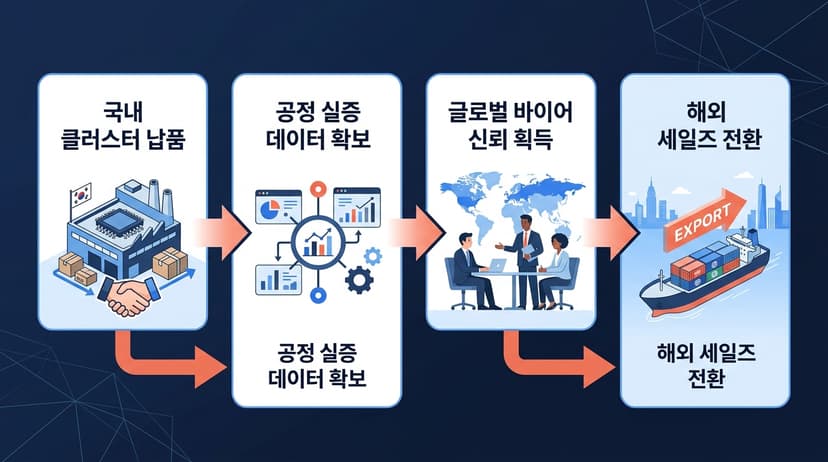
What does faster completion mean? It means the empirical testing and deployment of domestic parts and equipment in the manufacturing process will be fast-tracked just as quickly. The track record secured rapidly within these massive domestic clusters serves as the ultimate quality guarantee and export reference to convince global buyers.
550 Trillion Won AI Data Centers: Breaking into Global Tracks for Domestic Solutions with Supply Track Records
The second opportunity lies in AI data centers. Partnering with companies like SK (for a phased 15GW expansion), GS (2.4GW), and Naver (1GW), a massive infrastructure with a total capacity of 18.4GW will be built. The investment attracted for this alone reaches a whopping 550 trillion KRW.
The most eye-catching part is that the government has explicitly stated it will directly support global buyer matchmaking and market entry for domestic NPU chips, power, and cooling solutions. If your company possesses related technologies, we highly recommend utilizing KOTRA support programs or Export Vouchers to proactively secure trade guarantees and official certifications. The Power Usage Effectiveness (PUE) data validated within Korea's 18.4GW infrastructure is the ultimate weapon global buyers are most eager to see in cold emails.
How you broadcast these hard-earned export references to the global market is equally crucial. According to our observations of 2025 data, exporters that maintained multi-lingual websites (including English, Japanese, and Chinese) achieved a noticeably more balanced geographic distribution of organic search traffic compared to those using only Korean. (Of course, results can vary significantly depending on translation quality and the SEO authority of the existing site.)
Defending Against Strict Factory Audits with Data Factories
The next thing buyers ask about relentlessly after your track record is the Factory Audit. Leveraging the physical AI robot foundry built in Saemangeum and transitioning manufacturing facilities into data factories (the M.AX strategy) means far more than simple cost reduction.
Global buyers do not just want to see a single perfectly crafted product; they want to verify your agile manufacturing capabilities to maintain consistent quality across tens of thousands of units. By participating in domestic robot distribution initiatives and systematically gathering real-time process control data, you can build a solid proof of quality consistency that easily handles any strict audit a buyer throws at you.

The Flip Side of Expansion: How to Avoid Becoming a Simple Subcontractor
However, a chilly risk hides behind these glittering large-scale infrastructure developments. Since semiconductors and data centers consume massive amounts of power and water, global tech giants closely scrutinize whether their Korean supply chains meet RE100 (100% renewable energy) targets. If you fail to pass the carbon neutrality threshold, your hard-earned supply track record could instantly become useless, resulting in immediate exclusion from their supply chains.
Simply supplying equipment or hardware and calling it a day is no longer enough. We recommend leveling up your offerings by combining your hardware with monitoring SaaS solutions to present high-value, comprehensive data packages to buyers. This is how you avoid becoming a disposable, low-margin subcontractor.
Once you create that initial touchpoint with a buyer using your export references and value propositions, it becomes a game of precise timing. Based on internal observations from the Rinda platform (as of Q4 2025), companies that sent their first follow-up within 48 hours of an exhibition or cold email saw significantly higher global buyer response rates compared to those that followed up a week later. (While this limited sample may contain industry bias and long-term procurement decisions may follow a different path, speed is key to capturing initial trust.)
Written by · Rinda Export Sales Research Team (Global Buyer Prospecting & Export Sales Automation Research Editors)
We compile highly actionable export strategies and checklists based on the pipeline data of over 200 Korean exporters and internal observations from the Rinda platform.
It is time to deliver your valuable track record, forged through domestic mega-projects, straight to the monitors of global buyers. If you are unsure which country or which buyer to target with cold emails using empirical data from these 1,431 trillion KRW high-tech hubs, we highly recommend checking out Rinda, an AI platform that automates global buyer prospecting and sales for exporters.
Rinda's global buyer coverage boasts a scale of over 800 million business data points across more than 200 countries based on its own metrics. (Of course, depending on where it is published, such as on the homepage or in press releases, there may be slight differences in figures, such as 150 countries, 500 million, or 85,000+.) Notably, press coverage from outlets like beSUCCESS and StartupN (2026.01.06) highlights the fascinating performance of 'Rinda 2.0,' the autonomous AI sales agent officially launched this January. Simply input a company’s website URL, and it automatically identifies potential buyers and sends tailored proposal emails. Try the free demo today to sharpen your company's export references into a powerful global sales weapon.
You don't have to figure export out alone
From finding buyers to closing deals, Rinda is with you. Book a free 30-minute chat to see how we can help.