Export Marketing: Why 'Reasons for Rejection' Matter More Than 100 Buyer Business Cards
We look into why post-exhibition buyer reports look promising but result in zero deals. To stop wasting export voucher budgets, you must gather specific rejection reasons rather than polite praise. Explore practical export marketing strategies, from setting test marketing hypotheses to onsite feedback templates.
Key takeaways
- The true purpose of participating in international trade shows is not to generate immediate sales, but to test hypotheses in the local market and collect specific reasons for rejection.
- Use the feedback collected to identify the real reasons buyers hesitate to purchase (price, packaging, ESG alignment, etc.). This is how you significantly increase pipeline conversion rates.
- We recommend not relying entirely on local partners or agencies. Design practical next actions using an 'export feedback template' directly controlled by the export manager.

"The buyers' response was amazing. We even collected over 100 business cards."
This is a classic line heard in debriefing meetings after returning from international trade shows. But three months later, how many of those 100 business cards actually lead to a real Purchase Order (PO)?
To be honest, most end in a disappointing zero. Despite pouring tens of thousands of dollars into export marketing, the pipeline remains completely empty. This happens because we only collected half-hearted praise from buyers on-site. The success of export marketing does not depend on how much praise you receive.
The real key is how many specific reasons for rejection—why they won't buy our product right now—you managed to secure.
Trade Show Marketing: Are You Only Collecting Polite 'Nices' from Buyers?
Many are encouraged by buyers saying things like "Interesting" or "Nice design" at trade show booths, happily reporting positive feedback back to headquarters. However, when a European buyer says "interesting," it is by no means an intent to buy. There is a 90% chance it is simply polite small talk.
Let's look at the data from the KOTRA 2025 European Consumer Goods Trend Report. In Western Europe, particularly in markets like France, simple product specs or cost-effectiveness do not work anymore. Instead, a brand's core values around sustainability, such as ESG or upcycling, serve as essential purchasing criteria. Having good technology and a low price might earn you light praise, but it is not the key factor that makes them open their wallets immediately.
In fact, a case study from a test marketing support program hosted by a French public institution (Source: note.jp) clearly demonstrates this difference. A small Japanese upcycling brand did not rush to participate in exhibitions or enter retail stores. Instead, they first validated: "What kind of psychological resistance would local consumers feel toward our upcycled materials?" They intentionally tracked negative reactions to avoid vague praise and close the gap with local sentiment.

As an export sales manager, we hope you don't obsess over collecting 100 business cards for successful buyer prospecting. We recommend making it your primary goal to extract even a single raw reason for rejection, such as "It's too expensive to buy" or "The packaging looks too cheap to put on our shelves."
Shifting Export Voucher Exhibition KPIs from 'Booth Attendance' to 'Hypothesis Testing'
Every year, numerous companies board planes using export voucher exhibitions or municipal budgets. However, looking at the global marketing KPIs of many companies, they often stop at "booth participation completed" or "achieved N consultation meetings." This is equivalent to burning tens of thousands of dollars on a simple attendance check.
Real global test marketing is different. It must be a process of relentlessly asking and dissecting whether our brand identity resonates locally. Check out the table below to see how the traditional approach compares to the hypothesis-testing approach.
| Category | When to Use (Purpose) | Key Output | Next Action |
|---|---|---|---|
| Traditional Passive Attendance | Participating 'just to get exposure' without a specific target | 100 business cards, "Positive response" report | Sending mass emails and waiting indefinitely |
| Hypothesis-Testing Attendance | When verifying if a specific selling point works locally | Specific reasons for rejection, areas for improvement | Readjusting target list, pivoting product/packaging |
There is a key point you shouldn't miss in this table. Only when the hypothesis is clear can an exporting company sharply define the 'next action' to take after the exhibition ends.
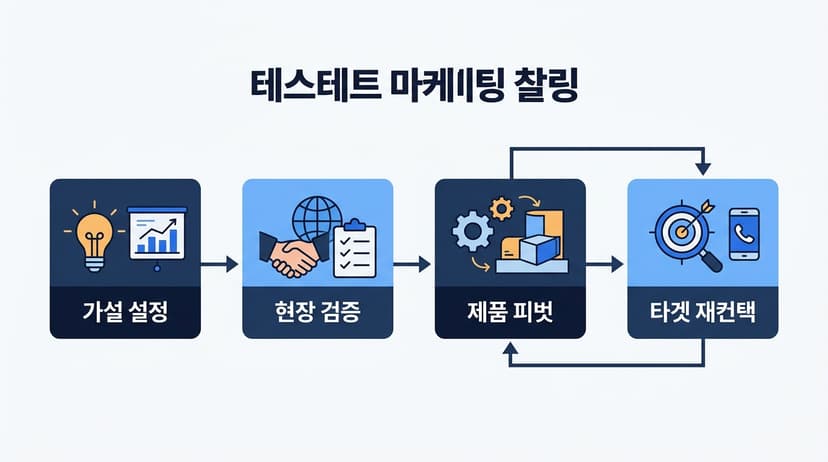
Before departing, make sure to ask this question internally: "Does our product's core value align with the sourcing criteria of our local target buyers?" Without a hypothesis, there is no meaningful feedback. Please remember that without feedback, you cannot take a single step forward to the next stage.
The 'Export Feedback Template' You Shouldn't Outsource to Local Agencies
Companies often experience painful setbacks when conducting market research with export voucher partner agencies or local marketing firms. This happens because they delegate the feedback collection entirely to them. When you open the reports brought by agencies, nine times out of ten, they contain obvious sentences like "Price is 15% higher than the local average" or "High interest due to unique design." No matter how competent an agency is, it is difficult for them to grasp the detailed strengths and cost structures of your product as deeply as an in-house manager.
Do you want to get truly useful buyer prospecting data? If so, we recommend taking control by equipping your export sales team with a specific questionnaire template to ask buyers directly on-site.
- Question 1: "If you were to place this product on your shelves right now, what would be the biggest obstacle?" (Price, packaging size, ingredients, etc.)
- Question 2: "If you have experience sourcing similar products from Korea, what was the biggest issue you faced at the time?"
- Question 3: "Do you believe our brand's ESG (eco-friendly) story will be persuasive enough to convince local consumers to buy? If not, what is lacking?"
The sharp reasons for rejection gathered this way only reveal their true power after the trade show ends. When we tracked the data ourselves, the results were astonishing. The group that sent their first follow-up email within 48 hours—containing plans to address the issues raised by the buyer (such as lack of certification or packaging style)—had a significantly higher response rate than the group that sent a simple thank-you note after 7 days. Actively listening to the buyer's painful rejection and presenting immediate countermeasures acts as an incredibly powerful sales weapon.
Author · Rinda Export Sales Research Team (Overseas Buyer Prospecting & Export Sales Automation Research Editor)
Based on the global buyer prospecting pipeline data of 200+ Korean exporting companies and internal observations from the Rinda platform, we compile strategies and checklists that can be put to immediate use in export practices.
Have you successfully validated the real reasons your product works on-site and the clear criteria of your target buyers? If so, it is now time to use that valuable data as a weapon and start actively searching for genuine buyers worldwide.
You can set aside the old, passive, and daunting listing methods for a moment. Try using 'Rinda', an AI platform that automates the entire process of global buyer prospecting and sales for exporting companies. You can scale up your meetings with sharply validated target buyers much faster and wider.
For your information, Rinda searches for the perfect buyers across over 200 countries and supports localized outreach in more than 17 languages. If you are curious about how Grinda AI's unparalleled AI export automation technology fills your pipeline, we highly recommend checking the links below.
- Rinda (Global Buyer DB & Cold Email Automation): https://rinda.ai/?utm_source=rinda_blog&utm_medium=organic&utm_content=100
- Grinda (AI Export Automation & Company Profile): https://grinda.ai/?utm_source=rinda_blog&utm_medium=organic&utm_content=100
Frequently Asked Questions
Q. Should headquarters design the questions themselves even when conducting market research through an export voucher partner agency? A. Yes, headquarters absolutely must design them. While agencies provide excellent local language skills and networks, the person who knows the underlying hypothesis and the weaknesses to overcome best is ultimately the in-house manager. Do not vaguely leave it up to the agency. Handing them a checklist of 3 specific rejection reasons you definitely want to test on-site—this is the foundation of successful export marketing.
Q. What should we do next if we have gathered a lot of negative feedback from the target market? A. Put that painful, collected feedback into immediate action. Reflect it right away by improving product packaging, changing payment terms, or pivoting your selling points in buyer cold emails. Negative feedback is not a sign of failure, but a valuable cost paid to confirm the buyer's precise needs. Simply sending a new proposal that incorporates this feedback back to the buyer within 48 hours can boost your response rate to an incomparable level.
Related resources
You don't have to figure export out alone
From finding buyers to closing deals, Rinda is with you. Book a free 30-minute chat to see how we can help.