
Why PDF Catalogs Bring Zero B2B Buyers
In 2026, B2B buyers delegate supplier discovery to AI agents instead of search engines. Learn how fancy PDFs and email gates block your export inquiries, and how SMEs can revamp their websites to be AI-friendly.
Key takeaways
- B2B buyers have fully shifted their search behavior from Google keyword searches to automated delegation via AI agents.
- Gated PDF catalogs that require an email address block AI crawling, completely eliminating your inbound export opportunities.
- Clear HTML tables and Schema Markup, though less visually flashy, are the new essential assets for successful B2B buyer discovery.

Did you spend thousands of dollars building a flashy, responsive English website? You carefully crafted an English catalog hoping for successful B2B buyer discovery, but are you getting zero inquiries? Paradoxically, that visual flashiness might be the very obstacle blocking your export path.
Many export sales managers simply upload offline trade show brochures straight to their websites. Or they hide their catalogs behind lead capture forms to collect buyer emails. In the past, this was a perfectly valid lead generation strategy. Today, however, this approach has become absolute "export poison" in the global market.
Finding B2B Buyers: The Era of AI-Delegated Sourcing
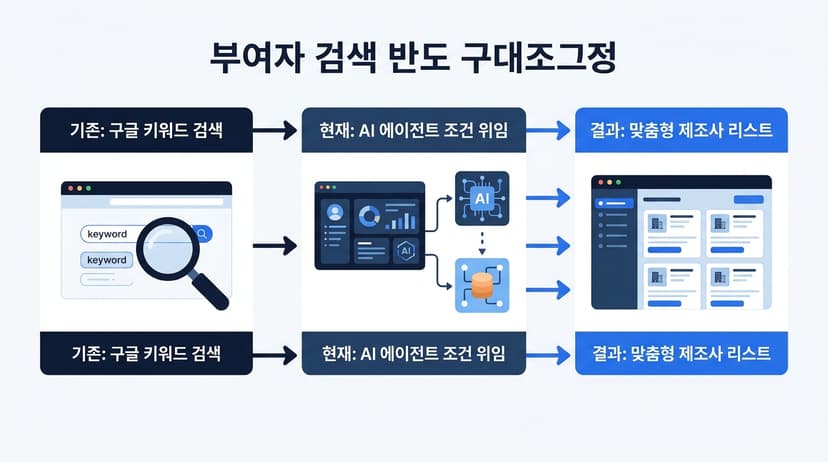
In the past, buyers typed keywords like "Korean OEM skincare" into Google, clicked on top-ranking websites, and manually compared pricing. Now, the starting point of the B2B buyer journey has completely changed.
An analysis published by MarTech (Optimizing your B2B brand for autonomous AI shoppers) highlights this shift. Buyer behavior has moved from manual search to an "Automated Delegation Model" run by AI agents. Essentially, a buyer's AI assistant now handles everything from initial sourcing to mid-funnel filtering.
Instead of pulling up a search engine, buyers now prompt their AI agents: "Create a price comparison sheet of Korean vegan cosmetics manufacturers with CGMPs and an MOQ of under 5,000 units."
According to internal data from the Rinda platform, we observed a distinct quarter-over-quarter increase in inbound inquiries for Korean beauty, food, and smart home appliances in Southeast Asia and parts of the Middle East. (While there are variations by category and country, and exchange rates or regulatory shifts play a role, the trend is clear.) The key takeaway here is whether a buyer's AI can recognize your company as a "qualified supplier" and include you in its recommendation list when demand spikes.
Why Gated PDF Catalogs Have Become Poison for Export Marketing
So, why is a well-designed PDF catalog a problem? The answer lies in how AI agents operate.
An AI agent won't politely fill out an email form and click "Download" on behalf of a buyer. If your core product information is gated behind a form, the AI simply moves on to the next supplier's website. No matter how superior your product specifications are, you will be completely excluded from the recommendation list.
The same goes for responsive websites packed with heavy JavaScript. Detailed pages with animated graphics or flat text embedded inside static images are just empty shells to an AI crawler. Paradoxically, the most visually stunning website to human eyes is categorized as having "zero information" by AI.
Why Plain HTML Tables Outperform Flashy Web Design
Digital visibility in B2B is no longer about visual layouts. The "structural readability" of your technical data has become far more critical. What AI agents crave is not fancy design, but raw data and plain HTML tables.
When critical information like product specs, certifications, and MOQs are structured using search engine standards (Schema.org markup), your indexing authority—which determines how easily AI can crawl and categorize your data—reaches its peak.
| Category | Traditional English Website | AI-Friendly English Website |
|---|---|---|
| Core Content Format | High-res images, PDF downloads | Plain text, HTML tables, schema markup |
| Design Structure | Heavy JavaScript, responsive animations | Clean, intuitive text hierarchy |
| Lead Capture Method | Gated (Access files after entering email) | Open (AI crawls specs and summarizes for buyers) |
| Optimization Target | Human visual satisfaction | AI crawler data extraction efficiency |
The absolute key takeaway from the table above is information openness. You must abandon the outdated practice of gating content behind email forms. If you want successful B2B buyer discovery, you need to openly share clean text data that matches buyer criteria. Only then will your company name make it to the final decision-maker's desk.
3-Step AI-Friendly Website Revamp for Exporting SMEs
You don't need a massive development budget to rebuild your English website from scratch. Even resource-constrained startups or novice exporters can immediately boost their AI readability by following these three steps.
1. Establish a Crawling Control Strategy (Security First)
You don't have to leave everything completely open. To prevent intellectual property (IP) or proprietary pricing from leaking, use your robots.txt and meta tags strategically. Allow AI agents to crawl standard specifications and certifications, while setting highly sensitive pricing sheets to Disallow.
2. Convert PDF Content to Plain Text
What about the product specifications and translated documents you compiled using export vouchers? Copy that text directly and paste it onto your webpage. Make sure to structure technical specifications neatly using HTML <table> tags.
3. Add an Open Q&A Section Write out full-sentence answers to the questions buyers ask most frequently (MOQ, lead times, payment terms, etc.) and place them at the bottom of your webpage. For AI agents processing highly specific natural language queries, this is the ultimate source of high-quality answers.

Author: Rinda Export Sales Research Team (B2B buyer discovery and sales automation research editors)
Drawing from internal data on the buyer discovery pipelines of over 200 exporting companies and insights from the Rinda platform, we curate actionable export sales strategies and checklists.
Now that you have optimized your inbound setup for buyers' AI agents to crawl your specifications seamlessly, it is time to proactively reach out to qualified buyers.
Partner with Rinda, an AI platform designed to automate B2B buyer discovery and sales outreach for exporters. Experience proactive outbound sales that secure cold email replies in just a few days. If you are seriously considering sales automation, solutions from Grinda AI are also a powerful and reliable alternative.
Frequently Asked Questions
Q. Should we completely discard our existing PDF catalogs? A. No. While AI agents handle the initial search and filtering, human decision-makers still prefer downloadable files during the final review stage. We recommend a two-track strategy: place easy-to-digest plain text and HTML tables on your web pages for AI, but keep your PDFs open for download with a single click—no email address required.
Q. If we only use plain text and tables for AI, won't our website look unappealing to human buyers? A. Absolutely not. This does not mean sacrificing aesthetics. Keep your clean layout for human visitors, but ensure the underlying data is hardcoded as structured text rather than flattened inside images or heavy JavaScript. In today's global B2B sales funnel, presenting accurate specifications instantly outperforms flashy, slow-loading animations every time.
Want export insights in your inbox?
We'll send one email summarizing new posts from our blog and resource library.