Get 10% buyer response with WhatsApp AI
If your cold email open rate is under 10%, it's time to switch sales channels. Explore Meta's WhatsApp AI Agent adoption strategy and lead screening data.
Key takeaways
- If your proposal email open rate is under 10%, we recommend gradually transitioning your sales channel to WhatsApp, the messenger on every buyer's smartphone.
- Meta's 'WhatsApp Business AI' features, which are being actively rolled out for enterprises, leverage over 1 billion daily business conversations to help lower initial bounce rates far more effectively than email.
- Instead of fully automating your sales, use AI as a 'qualified buyer screening' tool. Build a hybrid pipeline that gauges budgets across time zones and hands off only the hottest leads to your human sales team.
To achieve successful overseas buyer discovery, we often send out carefully crafted cold emails (the initial email sent to introduce your products and proposals to a new prospect). However, if your open rates consistently hover below 10%, it is time to evaluate not just the content of your message, but the communication channel itself. Waiting for buyers to find you through a passive website chatbot is no longer enough to stay competitive. Today, B2B export success depends heavily on building 'conversational sales' channels that naturally blend into the messaging apps buyers use every day.
Are you still taking a full day to reply to buyer inquiries because of time zone differences? If so, you are likely losing a significant portion of your sales pipeline to competitors who offer instant, 24/7 initial responses. To boost your efficiency and shorten the buyer's purchasing journey, let's look at how messenger-based AI systems can be applied to real-world export sales.
1 Billion Daily WhatsApp Business Chats: The Pipeline is Shifting
After extensive testing in highly messenger-centric emerging markets like India and Mexico, Meta is rolling out WhatsApp Business AI features globally. The message for exporters is clear: you don't need to abandon traditional email entirely, but you must pair it with a channel that buyers check dozens of times a day.
Market data strongly supports this shift. Recent global IT and business reports show that WhatsApp is quickly approaching 3 billion monthly active users, with daily business-to-consumer messages already exceeding 1 billion. In Meta's recent earnings calls, revenue from Click-to-WhatsApp ads and paid messaging has shown a sharp upward curve, reaching a multi-billion dollar annual run rate (ARR). This demonstrates that buyers increasingly prefer mobile messaging over email when communicating with businesses.
The limitations of traditional outreach are even more evident on the ground. Internal research from 'Rinda'—an AI platform that automates overseas buyer discovery and sales—shows that companies following up within 48 hours of an overseas trade show (international exhibitions where companies promote products and meet buyers in person) see a significantly higher reply rate compared to those who wait 7 days.
While exact figures vary by industry and payment terms, the core of improving buyer response rates boils down to timing and accessibility. While email structurally struggles to guarantee an immediate response within 48 hours, an AI agent connected to the WhatsApp Business API bypasses time zone barriers to deliver instant, 24/7 engagement.
The Real Goal of AI: Lead Screening, Not 100% Export Automation
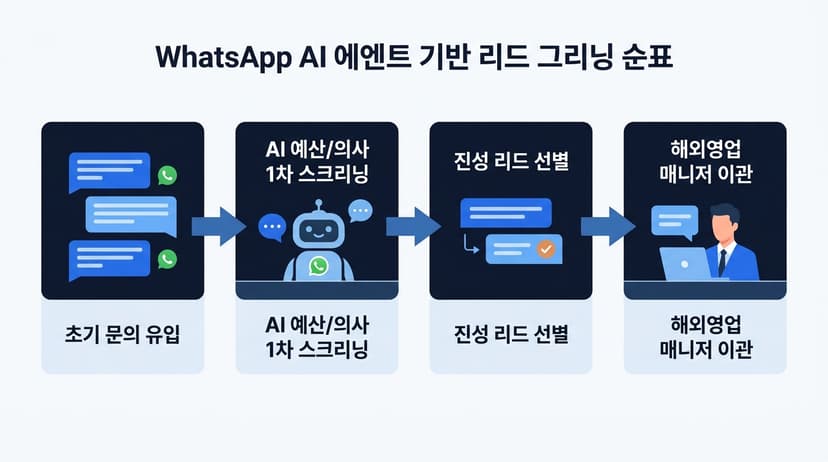
Export sales managers considering WhatsApp AI agents should avoid one common pitfall: expecting AI to handle 100% of complex trade negotiations. B2B exports involve complicated regulations, logistics, and trade finance across borders. Attempting to fully automate this process can introduce unwanted risks.
Instead, the true purpose of an AI agent is not full export sales automation. It lies in quickly filtering a buyer's budget, MOQ (Minimum Order Quantity: the minimum amount of product a manufacturer requires to produce or sell), and purchase intent, then ensuring a 'seamless handoff to export sales managers' for qualified, high-probability leads.
Let the AI handle routine catalog requests, basic price inquiries, and lead qualification around the clock. Meanwhile, your sales managers can focus their energy on high-value tasks that drive conversions—such as negotiating the terms of a Letter of Credit (L/C) (a document issued by an importer's bank guaranteeing payment to the exporter to ensure safe trade), discussing exclusive distribution rights, or modifying technical specifications.
| Category | Traditional Email-Centric Sales | WhatsApp AI Agent Hybrid Sales |
|---|---|---|
| Initial Response Speed | Averages 24–48 hours (due to time zone differences) | Instant response & basic guidance (24/7) |
| Lead Screening | Sales reps manually analyze and reply to emails | AI pre-screens budget/intent and delivers key summaries |
| Sales Team Resources | Large portion of work hours spent responding to basic inquiries | Focus resources on negotiating and closing deals with key buyers |
As the table highlights, the success of AI adoption depends on how effectively you can reallocate your sales team's valuable time from repetitive tasks to strategic negotiations.
Practical Guide: Launching WhatsApp AI Outbound Sales (Action Items)
How can you implement this in your daily operations? Here is a step-by-step process and checklist you can start using today.
📍 Step 1: Analyze Target Countries and Buyer-Preferred Channels
WhatsApp is not universally dominant. While it is the primary business channel in the Middle East, Latin America, India, and Southeast Asia, other regions prefer different tools—such as email/SMS in the US, LINE in Japan, or WeChat in China. Always identify the leading messenger in your target market first.
📍 Step 2: Connect WhatsApp Business API and Set Up Information
You must use the official enterprise API (not the personal app) to connect with CRM systems or AI chatbots. At this stage, configure your basic product data:
- Essential Inputs: Company profile, digital catalog link, HS Codes (Harmonized System: a standardized numerical method of classifying traded products to determine tariff rates) for key products, standard MOQ, and sample policies.
📍 Step 3: Write an Initial Outbound (Cold Message) Template
Keep WhatsApp messages much shorter and more direct than traditional emails. Here is a template you can customize for your business:
[B2B Cold Message Template Example] "Hi [Buyer Name], I'm [Your Name] from [Company Name], a South Korean manufacturer specializing in [Product Category, e.g., medical devices]. I've been following [Buyer's Company Name]'s impressive growth in the [Market/Industry] sector. We help distributors of your size improve their [Expected Benefit, e.g., margins by 15%] with our products. Would you like to view our product catalog and export price list (FOB) directly via our chatbot?
- View Catalog
- Check Minimum Order Quantity (MOQ)
- Chat with a Representative"
✅ WhatsApp-Based Sales Pipeline Adoption Checklist
- Have you verified that WhatsApp is the primary business communication channel in your target buyer's country?
- Have you clearly defined the criteria for a 'qualified buyer' (e.g., minimum monthly budget of $10,000) for the AI to screen?
- Is your workflow set up to instantly alert a sales representative when a buyer asks a complex question or is ready to close?
- Have you checked if you can utilize government subsidies, such as the Export Voucher program (government-issued vouchers providing subsidies to help SMEs expand globally), to offset initial setup costs?
Overcoming Realistic Barriers to Improving Buyer Response Rates for SMEs

Adopting new channels comes with practical challenges. Unlike integrated ecosystems like WeChat in China, WhatsApp in Western and other global markets still has limitations when it comes to handling large-scale B2B transactions directly inside the app. This means that even after a successful initial chat, you must eventually transition buyers to traditional email or e-signature tools to finalize contracts and wire transfers. Additionally, session-based charging models can be a budget consideration for smaller businesses.
Rather than launching AI agents across all global markets at once, we recommend a targeted approach. Run a pilot test focusing on your top 20% high-potential VIP buyers, or target specific countries in Southeast Asia, Latin America, or India where business communication is heavily messenger-centric.
When precise targeting meets the right channel, sales pipelines move incredibly fast. Take the case of Company I, a South Korean manufacturer of premium eco-friendly Hanji cooling bedding. By using Rinda's data to compile a highly targeted buyer list, Company I initiated focused outbound sales. By targeting verified leads through their preferred channels, they secured meetings with global buyers in just 7 days.
This approach led to sample testing and specification negotiations with Australia's premium retailer 'Halcyondream', as well as securing a partnership with Singapore's Robinsons Department Store. While a 7-day turnaround may not happen for every industry due to the complex nature of B2B trade, combining data-driven targeting with real-time messaging consistently yields outstanding results.
Written by Rinda Export Sales Research Team
We analyze pipeline data from numerous exporters and monitor the Rinda platform to deliver practical, actionable strategies and checklists for global sales teams.
Building a real-time, cross-border pipeline with WhatsApp AI is a highly effective strategy for modern exporters. If you want to systematically automate your export sales automation from discovery to outreach, consider using an AI platform optimized for your specific products and target markets to build your next-generation sales pipeline.
- Discover the Rinda Solution: https://rinda.ai/?utm_source=rinda_blog&utm_medium=organic&utm_content=whatsapp_ai
- Learn about Grinda (AI Export Automation): https://grinda.ai/?utm_source=rinda_blog&utm_medium=organic&utm_content=whatsapp_ai
"Don't limit your competitive edge to the email inbox. Engaging buyers smoothly on their preferred mobile messengers is the new standard for modern B2B export sales."
Frequently Asked Questions (FAQ)
Q. What is the first step to get started with WhatsApp AI outbound sales? A. As outlined in our guide, you must first set up an official 'WhatsApp Business API' account rather than using a personal profile. Once connected, feed your AI basic export terms such as HS Codes, MOQ, price lists (FOB, CIF, etc.), and sample policies. The more precise this initial setup, the higher the quality of the leads handed off to your sales team.
Q. Can I expect the same results in markets like the US, Japan, or China? A. Messenger preferences vary heavily by region. While WhatsApp is dominant in Latin America, India, Southeast Asia, and parts of Europe, B2B buyers in the US rely more on traditional email, SMS, and iMessage. Meanwhile, Japan and Taiwan favor LINE, and China operates on WeChat. We recommend tailoring a multi-channel strategy based on the cultural norms of your target market.
Q. Can we automate everything from buyer discovery to outbound sales? A. Fully automating B2B transactions without human intervention is risky. The most reliable strategy is a hybrid approach: use automation to build target lists and handle initial outreach, then transition high-intent conversations to human sales reps. Platforms like Rinda can automate the heavy lifting of extracting verified buyer databases, helping you replace outdated, one-way buyer cold emails with real-time conversations that convert.
Want export insights in your inbox?
We'll send one email summarizing new posts from our blog and resource library.