Get Ghosting Buyers to Reply with Wrong Specs
Do you know why sending a perfect catalog keeps overseas buyers from replying? Learn how to use Cunningham's Law to trigger the human urge to correct, using intentionally wrong information to get ghosting buyers to reply with these reverse-psychology cold email templates.

A perfectly organized catalog, a fully packed company profile. What happens when you send these, dreaming of successful B2B buyer discovery? Paradoxically, it acts as a death sentence saying "no need to talk further." If you pour all your information into the very first email, buyers lose any reason to reply and ghost you. Keep sticking to this 'perfect' template, and the business cards you spent thousands of dollars in flight tickets to collect will head straight to the trash bin within two weeks.
Why Do Perfect Export Sales Emails Actually Lower Buyer Reply Rates?
The very first thing export sales managers do after returning from a business trip is bulk-emailing brochures to buyers who visited their booths. But here is a shocking piece of data. According to Gartner's '2026 B2B Buyer Behavior Analysis' report, 82% of decision-makers do not respond at all to one-way brochure attachments sent right after an exhibition.
On the other hand, samples observed within the Rinda platform told a slightly different story. Companies that executed their first follow-up within 48 hours of attending an overseas exhibition saw significantly higher reply rates than those that didn't. (Though this effect might be slightly lower in industries with long purchasing cycles, like heavy industries.) However, just as important as timing is the content of your message.
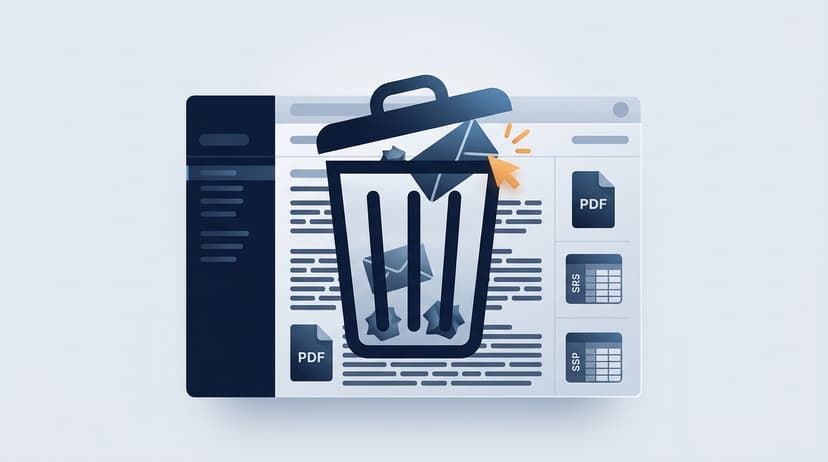
An email with all the specifications and pricing listed. Buyers read this, think "Got it, I'll contact them later if needed," and close the window. You've left absolutely no room for curiosity or questions. We call this the 'Explanatory Sales Trap.'
Throw a "Wrong Answer" Instead of a Question: Cunningham's Law
There is a very fascinating psychological principle on the internet called Cunningham's Law: "The best way to get the right answer on the internet is not to ask a question; it's to post the wrong answer." People are far more motivated to correct someone else's mistake than to answer a plain question. Bringing this psychology into B2B export marketing is what we call the 'Intentional Error Play.'
We recommend you stop asking ghosting buyers, "Are you interested in our products?" Instead, throw them slightly off-target information. Send something like, "I wanted to confirm if the specification you mentioned at our booth was Spec A, right?" Then, the buyer will willingly hit reply just to correct you: "No, we are looking for Spec B."
The real-world results are clear. Take the case of Company I, a natural cooling hanji (mulberry paper) bedding manufacturer featured on Rinda's landing page. They pulled immediate responses from buyers right after sending AI-driven, precisely targeted emails, securing overseas meetings in just 7 days. Afterward, they initiated sample testing and supply spec discussions with 'Halcyondream,' a premium Australian brand, and even secured placement in Robinsons Department Store, a luxury retail hub in Singapore. (Of course, we cannot generalize that every industry and business will achieve this exact speed, but the impact made by precise targeting and a strong hook is undeniable.)
How to Write Intentional Error Cold Emails for Daily Sales
Here are templates you can apply to your export sales today.
Scenario 1: Pretending to slightly misunderstand specs or requirements "I wanted to confirm if you were looking for the 220V model we discussed at the booth." (Use this when the buyer is in a country that primarily uses 110V)
Scenario 2: Assuming they are using a competitor's solution "I assume you are currently using [Competitor A]'s solution for this, right?" (This coaxes the buyer into naturally revealing their internal setup by replying, "No, we developed it in-house" or "We use Company B")
The Secret of the '3-Word' Subject Line That Penetrates C-Level Mobile Screens
No matter how brilliant your psychological strategy is, it's useless if the buyer never opens the email. There is some interesting data in the analysis 'How to Stand Out in B2B Sales' by global B2B sales strategist Devin Reed. In one case, shortening the subject line of a cold email targeted at C-level executives to exactly three words skyrocketed the open rate to 97%.
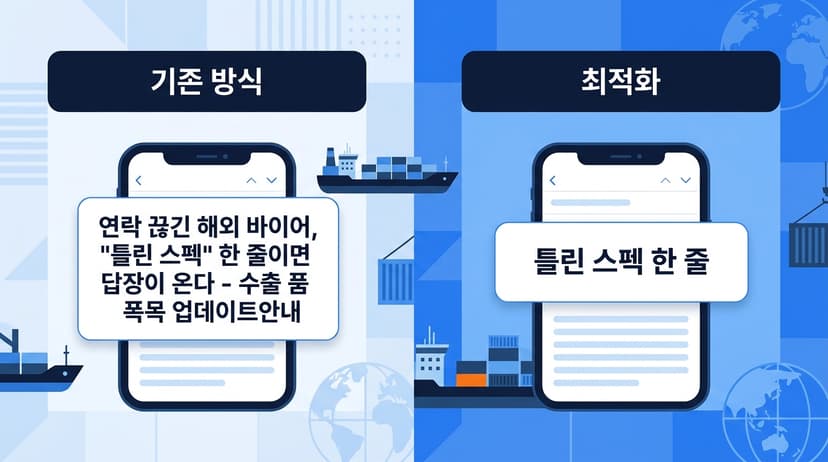
Most global decision-makers screen their emails on mobile devices while on the go. Cliché openers starting with 'Dear Purchase Manager' or dragged-out subject lines like 'Company introduction and proposal from...' are deleted within a second. You must drop a 3-word hook that fits neatly on a mobile screen, like "Quick question on [Brand]" or "[Competitor] vs Us," to pitch an offer they can't refuse.
Casual North America vs. Formal Asia: Adjusting the Nuance
However, you shouldn't blindly apply Cunningham's Law to all exhibition follow-ups. While direct correction plays work coolly with US buyers, they might come across as rude to buyers in Japan or Europe, where business etiquette is highly valued. If English isn't your native language, we highly recommend referring to the nuance adjustments below:
- For North American Buyers (Casual & Direct): "Quick check - were you looking for the 500g package?"
- For Asian/European Buyers (Polite Confirmation): "Please let me know if my understanding is correct: you mentioned prioritizing the 500g package during our chat."
Psychological Tactics are Ultimately a Matter of System
Getting buyers to reply with intentional errors is a great tactic. However, setting up this reverse-psychology play manually for hundreds of buyers using only Excel and Outlook has clear limits. Build a sophisticated sales sequence that automatically fires different messages at the right time depending on buyer reactions (opens, clicks, non-responses). That is how you keep your B2B buyer discovery pipeline flowing without running dry.
Written by · Rinda Export Sales Research Team (B2B Buyer Discovery & Export Sales Automation Research Editor)
We compile practical export strategies and checklists based on the export pipeline data of 200+ Korean exporters and direct observations within the Rinda platform.
If managing sophisticated cold email sequences to nudge B2B buyer psychology is getting too overwhelming to handle manually, we recommend leveraging system power. Design your own custom pipeline on our AI platform that supports B2B buyer discovery and export sales automation.
- Rinda (Overseas Buyer DB & Cold Email Automation): https://rinda.ai/?utm_source=rinda_blog&utm_medium=organic
- Grinda (AI Export Automation & Company Intro): https://grinda.ai/?utm_source=grinda_blog&utm_medium=organic
Frequently Asked Questions (FAQ)
Q. How many days should I wait between follow-up emails to a buyer who has gone silent? A. We highly recommend a 3-step sequence: a light reminder 3 days after the first email, an 'intentional error' email leveraging Cunningham's Law 5 days after that, and finally a break-up email 7 days later.
Q. What if I throw out a wrong answer and the buyer gets angry or loses trust? A. The key is not to make up completely wild, fabricated facts. Keep it at the level of a 'slight misunderstanding from a brief chat at the exhibition booth.' As long as you maintain a polite tone of verification (confirming details), you can successfully spark a conversation without hurting credibility.
Related resources
You don't have to figure export out alone
From finding buyers to closing deals, Rinda is with you. Book a free 30-minute chat to see how we can help.