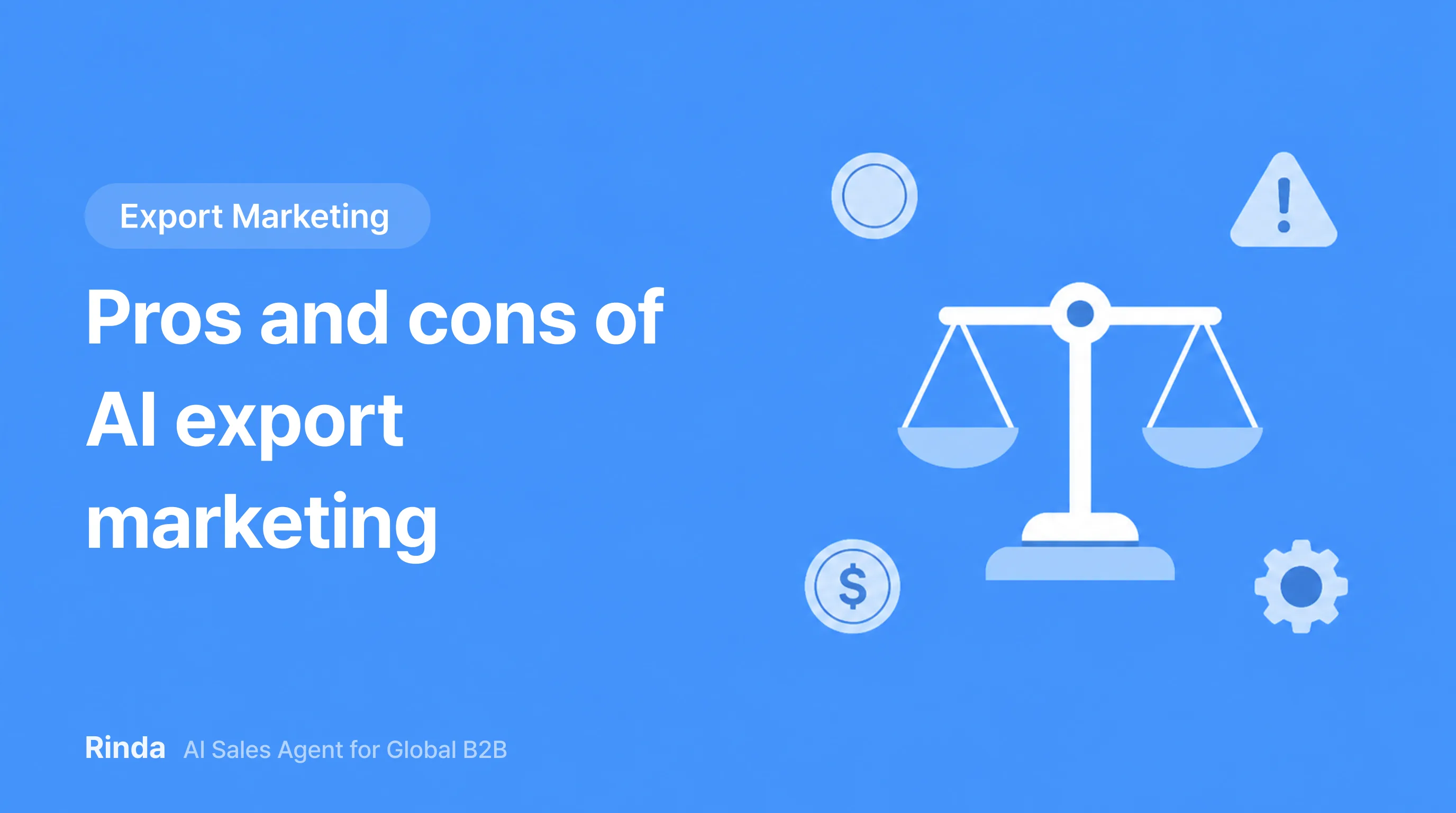
Pros and cons of AI export marketing
You've scaled up content production with AI automation — but overseas buyer responses haven't budged. Here's why. We break down exactly where AI delivers results in B2B export marketing, where it quietly destroys trust, and how small and mid-sized exporters can build a hybrid workflow they can use right now.
AI Content Automation in Export Marketing: Asset or Liability?
You're Producing Export Content 10x Faster with AI — So Why Are Buyers Still Silent?
If you've rolled out AI export marketing automation and overseas buyer responses haven't improved, this article will explain exactly why. You've been using ChatGPT to knock out English product sheets in minutes, automated your newsletter cadence — and yet buyers aren't biting. It's a wall that many export managers hit. The reason: content volume and sales performance are completely different metrics. According to Gartner's B2B buyer research, the average B2B purchasing cycle spans 6–18 months of complex decision-making. Across that long journey, the job of export marketing content isn't to deliver information — it's to build trust. Producing more, faster, is a fundamentally different problem from making buyers trust you.

The reason export marketing content is different from general B2C content is straightforward. In B2C, a single click drives a conversion. In B2B export, buyers read your content and immediately ask themselves: "Does this company actually understand our industry?" If your content fails to reflect export-specific context — industry nuances tied to HS codes, letter of credit (L/C) payment practices — then even flawless English grammar won't hold a buyer's attention.
What Export Content Automation Can Actually Deliver: An Honest Assessment
Without exaggerating: there are clearly defined areas where export content automation works. Time savings on repetitive tasks — drafting English copy, generating multilingual translation drafts, auto-generating SEO metadata — are hard to deny. For small export companies with a one- or two-person international sales team, writing weekly LinkedIn posts, email newsletters, and product landing pages in English from scratch is, frankly, close to impossible. AI tools deliver genuine value in the "structuring" and "first draft" stages.

A growing number of small exporters are using South Korea's Export Voucher Program (수출바우처) to offset the cost of AI-based content tools under the digital marketing support category. The program reimburses eligible companies for a portion of costs related to buyer discovery, marketing, and translation services. That said, eligible industry categories and annual budget availability change every year, so check the official KOTRA announcement directly before applying. Here's the critical distinction, though: content quantity goes up, but whether buyer response rates, lead quality, and meeting conversion rates move with it is an entirely separate question. Conflating the two is where automation loses its direction.
| Content Type | AI Automation Fit | Reason |
|---|---|---|
| English product spec sheet draft | ✅ High | Structured and repetitive |
| Multilingual translation draft | ✅ High | Speed and cost savings |
| SEO metadata and title tags | ✅ High | Pattern-based task |
| Trade show invitation email draft | ✅ Medium | Editing required |
| First cold email to a buyer | ❌ Low | Personalization and context essential |
| Case studies and delivery references | ❌ Low | Trust document — human voice required |
| Industry-specific technical blog posts | ❌ Low | Risk of technical context errors |
Three Situations Where AI-Powered English Marketing Automation Backfires
The first is context-free automation. European and North American manufacturing buyers are far more sensitive to contextual relevance than most exporters expect. When they receive a generic AI-generated message that reflects nothing about their industry or purchasing scale, one thought runs through their mind: "This company doesn't understand our business." That first impression becomes a negative bias that colors every subsequent sales communication.

The second is algorithmic risk. Through its Helpful Content system, Google has made clear that it prioritizes content that is genuinely useful to people, and that mass-publishing AI-generated content can negatively impact organic search visibility (Google Search Central, 2024). LinkedIn is similarly tightening its content quality signals. When reach drops on search and social platforms, it doesn't matter how much content you publish — buyers simply won't see it.
The third risk is the most paradoxical. As every exporter starts mass-producing similar content with the same AI tools, the scarcity value of content with a human voice and real-world experience rises sharply. The market is already saturated with an ironic reality: AI-generated content talking about AI content automation. Buyers are beginning to notice.
B2B Export Content Strategy: What to Delegate to AI vs. What to Write Yourself
A hybrid workflow with clearly defined roles for AI and humans is the practical answer — and the more limited your headcount, the more important that distinction becomes. The principle is simple: hand off repetitive, structured, and translation tasks to AI; keep trust-building, contextualizing, and relationship development with humans. Cold emails — your first point of contact with a buyer — should never go out as raw AI output. Because they set the first impression, personalization that reflects the buyer's industry, company size, and purchase history is non-negotiable.

A 3-Stage Hybrid Workflow:
Stage 1 — AI generates structure and first drafts: Use AI to draft English product specs, newsletter templates, and SEO metadata. This is where you save roughly 70% of your time.
Stage 2 — Your team edits for buyer context: Edit to match the target buyer's industry, country, and stage in the purchasing cycle. This is the "contextualization" stage — where content comes to life.
Stage 3 — Iterate based on performance data: Track buyer reply rates, click-through rates, and meeting conversion rates. Build a data record of which messages worked for which buyer segments.
Part of the initial investment in building this workflow may be eligible for support through the KOTRA Export Voucher Digital Marketing Program, subject to eligibility requirements. As always, confirm the current year's announcement and sector requirements before applying, since both shift annually.
If You're Not Measuring Content Performance, You Can't Justify the Investment in AI-Powered International Sales
If you're asking "We increased output — why aren't results improving?" — in most cases, automation was deployed without defined measurement criteria. Design your KPIs before implementing AI content infrastructure. Here are three metrics that carry real meaning in an export marketing context.
First, buyer email open rates and reply rates. On outbound email, track which subject lines and message tones actually generate replies from buyers. Within RINDA's observable platform data, companies that sent a first follow-up within 48 hours of a trade show saw noticeably higher reply rates than those that didn't — though the optimal follow-up timing varies by industry, country, and typical payment terms.
Second, time-on-page and inquiry conversion rate for landing pages and product pages. The benchmark is conversion, not traffic. More visitors mean nothing if they don't turn into inquiries. Third, lead quality by content acquisition channel. Raw traffic numbers are less useful than whether the leads that arrive actually meet buyer qualification criteria — purchase volume, geography, industry. A basic tracking setup using UTM parameters tied to your CRM is enough to give you a clear picture of content performance by channel.
The Bottom Line: AI Is the Fuel, Not the Engine, of Export Marketing
Automation without strategy is just a noise machine. The strategic question — what message, to whom, in what context — comes first. AI export marketing tools accelerate execution of that strategy; they don't replace it. Here's a pre-deployment checklist worth working through:
- Does your company have a clearly defined target buyer profile?
- Do you have metrics (reply rates, conversion rates) to measure current content performance?
- Is there a designated team member responsible for reviewing and contextualizing AI-generated drafts?
- Is the content you're automating in a trust-building stage or an information-delivery stage?
If two or more answers are "no," get the strategy right before reaching for the tools. Within the RINDA platform, companies that maintained consistent English-language content channels consistently showed noticeably higher inbound lead generation — not because of sheer content volume, but because strategic direction combined with consistent publishing was the inflection point. Results vary by industry and whether paid distribution is in play, but this pattern has been observed consistently.
Author · RINDA Export Sales Research Team (Research editor covering overseas buyer discovery and export sales automation)
Drawing on pipeline data from 200+ Korean exporters and internal observations from the RINDA platform, this team publishes actionable strategies and checklists for export practitioners.
For export managers wondering how to connect this hybrid workflow to actual buyer discovery and outbound sales, you can explore the full workflow — from overseas buyer database research to cold email automation — directly on RINDA. If you're curious about the broader picture of how export automation strategy comes together, Grinda is worth a look as well.
Frequently Asked Questions
Q. Can the Export Voucher Program cover the cost of AI content tools?
A. AI-based content tools may be included under the Export Voucher digital marketing support category, but eligible industries and annual budget availability change every year. Think of it as "eligible if conditions are met" rather than a guarantee, and always check the current year's announcement on the official KOTRA website before applying.
Q. Is it okay to use AI-generated copy in cold emails?
A. AI is perfectly useful for building the structure and first draft. However, personalization that reflects the buyer's industry, country, and purchase scale is mandatory before sending. Within RINDA's observable data, reply rates on non-personalized bulk emails were noticeably lower than on personalized outreach. The more important the first impression, the more human editing matters.
Q. How long before you can measure the impact of AI export marketing content?
A. Given that B2B export purchasing cycles average 6–18 months (Gartner, 2023 B2B Buyer Survey), judging content performance over a short window will lead you to the wrong conclusions. A realistic approach is tracking KPIs over at least three months to build data on which content types are driving buyer reply rates and meeting conversions.
Sources
Related resources
You don't have to figure export out alone
From finding buyers to closing deals, Rinda is with you. Book a free 30-minute chat to see how we can help.