Exporting farm robots to Canada and Japan
How a business school student team prepared 700 cold emails to export agricultural robots to Canada and Japan. Here are 5 tips from Rinda's sales team, covering buyer scope, search parameters, hooks, CASL/Japanese email regulations, and follow-up intervals.
A capstone team of seven business administration students from Chungnam National University took on the task of exporting agricultural robots for a Cheonan-based company in a KOTRA industry-academic cooperation capstone design class. The product they handled was an AI autonomous agricultural scouting robot designed for greenhouse and protected horticulture environments.
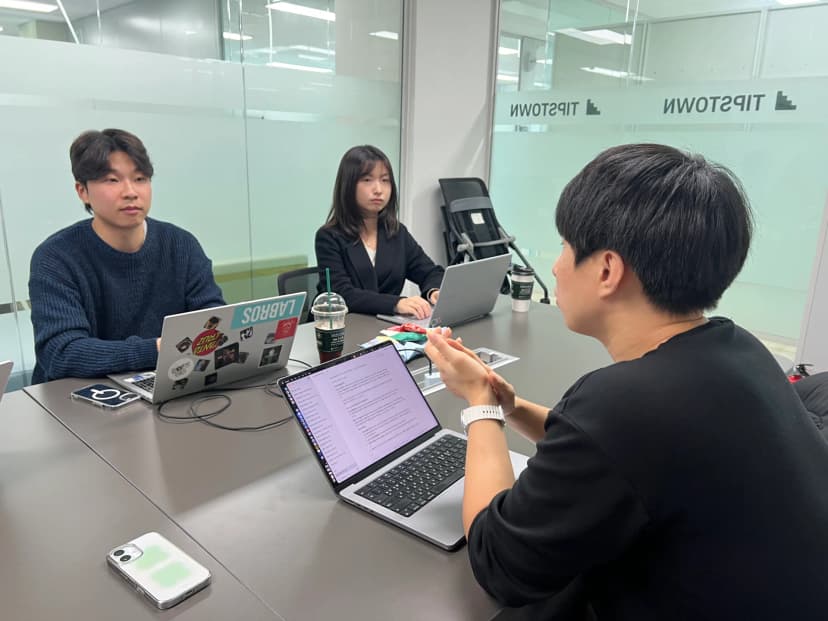
To find overseas leads, Chanwoo decided to send 700 cold emails to Canada and Japan within two weeks. To ensure a smooth process, he visited the Rinda office in person to review their global GTM strategy with Dongyeon, a professional on our sales team.

"Since We Were All Business Majors, We Knew Nothing About the Field"
In this class, KOTRA randomly assigns companies in the Chungnam and Daejeon regions. Usually, consumer goods companies like cosmetics or health functional foods are assigned, but Chanwoo's team was a unique case, getting matched with an agricultural scouting robot manufacturer.
Since we were all business majors, Rinda was incredibly helpful for us.
KOTRA evaluates the project based on the number of leads generated. So, Chanwoo decided to secure leads through cold emails and running ads, leaving them in a situation where they had to finish sending 700 cold emails within 7 to 14 days.
Why They Chose Rinda Over KOTRA
In fact, Chanwoo chose Rinda instead of the standard KOTRA platform typically used for the assignment. This was inspired by a presentation he happened to hear by Rinda's CTO, Jeongtae, at the Doryong Venture Forum on October 30th.
Rinda had so many great features. I created two workspaces using the free trial to test it out first, and the AI draft came out saying things like, "You're in smart farming, right? Then we can make these things possible for you." Seeing that, I immediately understood Rinda's unique buyer discovery formula.

- 3 Reasons the Capstone Team Chose Rinda
- Automation from Buyer Discovery to Follow-Up: Streamlined first greetings, product introductions, and final follow-ups to meet the 700-email target.
- AI Drafts Anyone Can Use: Simply fill in the sales information, and the AI generates a customized email draft tailored to the industry.
- Free Buyer Discovery: Extracted 700 Canadian buyers during the free trial period.
5 Tips from Rinda's Sales Team, From Buyer Discovery to Follow-Up Emails
After finding buyers through the free trial, Chanwoo needed advice on preparing for the actual email campaign. Dongyeon personally answered questions on which buyers to target and how to contact them.
Q: How do you expand the buyer pool for B2B industrial goods like agricultural scouting robots?
A: If you are entering an overseas market with industrial goods for the first time, you must target channel partners first. This includes agricultural equipment dealers, smart farm SIs (system integrators), and greenhouse builders. This is because end-users require installation, after-sales service, and local language support, which is difficult for a newly entering company to handle alone.
Therefore, in this case, we recommend starting with a mix of 70% channel partners and 30% large-scale greenhouse operators. However, for Japan, where trading companies and agricultural machinery dealerships hold strong traditional influence, you should increase the channel proportion even more. For Canada, we suggest targeting both operators and dealers in southwestern Ontario, where greenhouses are heavily concentrated.

Q: How do you filter for valid buyers in niche markets like greenhouses and protected horticulture?
A: If you input all search conditions at once, the AI might not distinguish between mandatory (AND) and optional (OR) conditions as intended. Instead, separate them into must-have conditions, nice-to-have conditions, and exclusion conditions. When the product and target countries are already set, having too many conditions actually increases the likelihood of failure.
- Try Changing Your Buyer Search Prompts Like This!
[Before] Inputting HS Code 8428.90, product, region, buyer type, and extra context all at once
[After]
- Mandatory (AND): Fix region (Canada, Japan) + only 1 buyer type (agricultural equipment dealer, smart farm SI, or greenhouse builder) first.
- Industry Terms (OR): Use industry terms instead of specific product names (English: greenhouse grower, commercial greenhouse, horticulture, agtech distributor, farm equipment dealer, smart farm integrator / Japanese: 施設園芸, 植物工場, 農業機械 販売, スマート農業, 農業資재 商社)
- Exclusions: Exclude HS Code 8428.90 as it might clutter the buyer type results.
Cramming in all conditions actually means you lack a focused strategy. You need to split your prompts and emails across three buyer groups to ensure proper personalization.
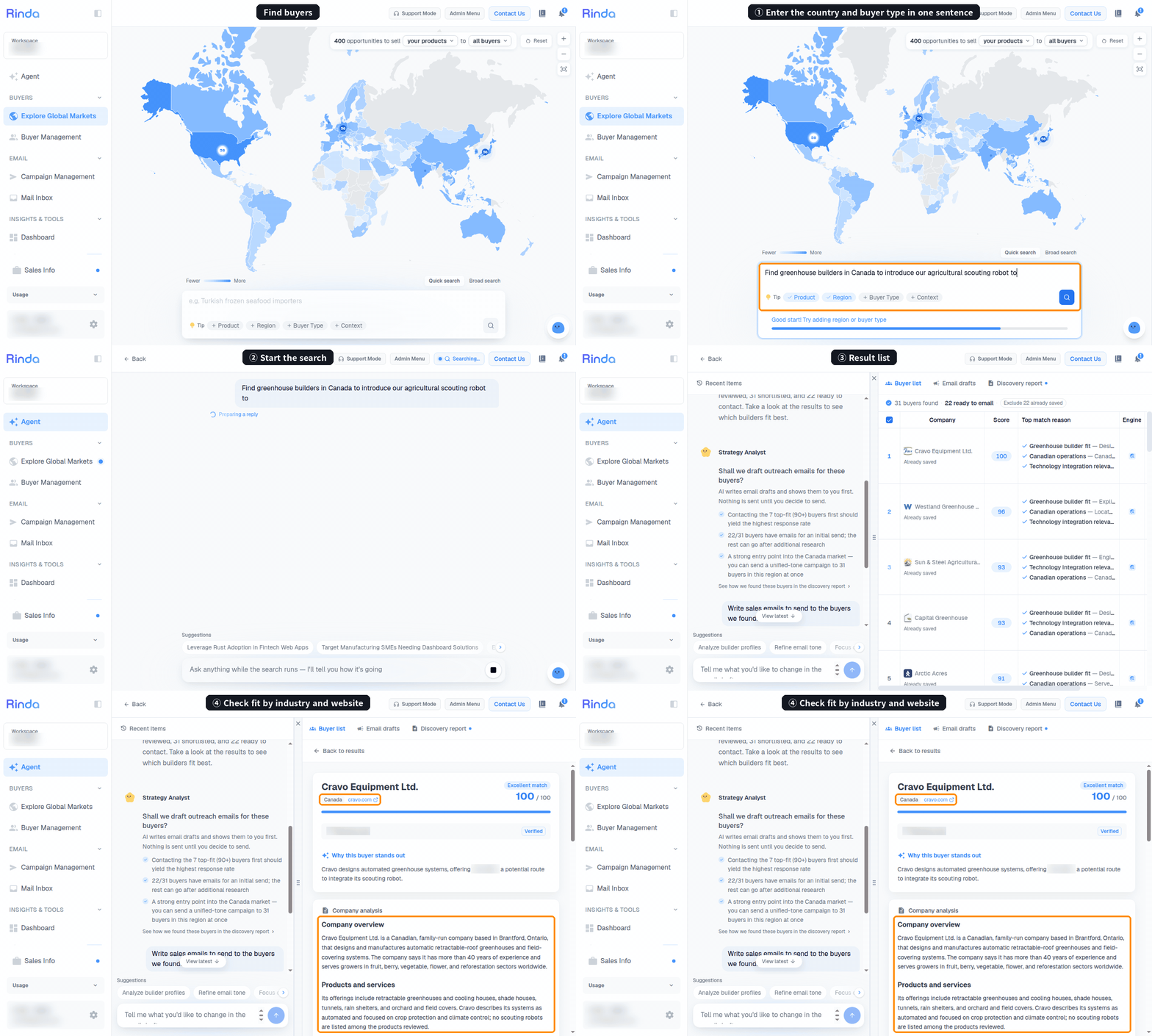
Q: What is important to get Canadian or Japanese buyers to open and reply to the first cold email?
A: Think of cold emails as a resume reviewed by a hiring manager. If you list out every single feature, they won't read it. Attaching a catalog in the first email can also land you in the spam folder, so it is best to send materials only when requested by the recipient.
Keep the subject line brief and focused on a pain point they face, like 'Cutting scouting labor in your greenhouse', and limit the body text to just 4 to 5 sentences. Instead of mentioning domestic patents, include a single compelling hook that appeals to the buyer, such as local certifications or global platform performance, and close with a low-friction request like, 'Would it be alright if I sent over some more information?'
If it is hard to define a single hook, try running separate A, B, and C campaigns and scale the one that gets the best response. For conservative Japanese buyers, lead with trust-building information in Japanese—such as company introductions, proof-of-concept records, and KOTRA affiliations. For Canadian buyers, keep it short and direct in English.
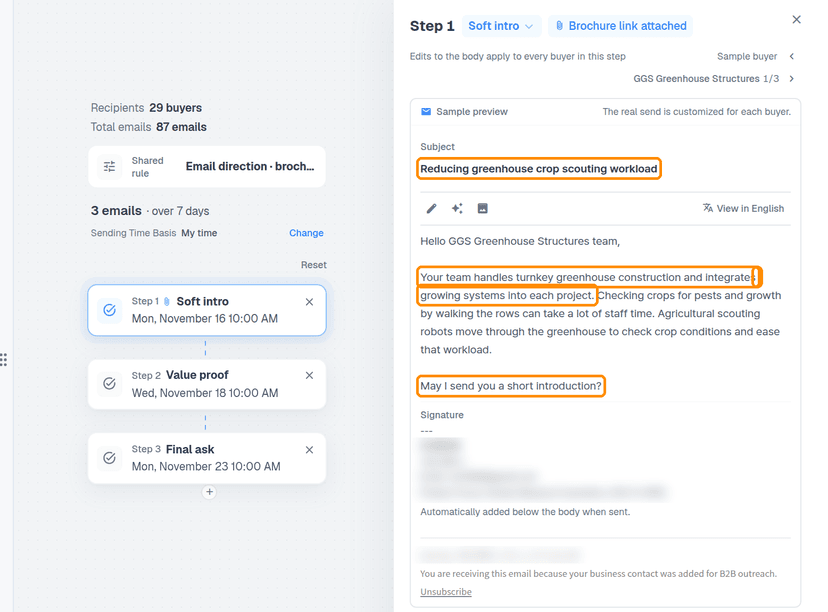
Q: How can we avoid violating Canada's CASL (Anti-Spam Legislation) or Japan's Act on Regulation of Transmission of Specified Electronic Mail?
A: First, regarding the sending environment, Rinda provides pre-warmed sending domains instead of using your main company domain. Domain warming is a process of gradually increasing sending volume from a new domain to be recognized as a legitimate sender by email services. The prefix of the email address can be customized with your company name. Rinda only provides public contact information where you can actually be reached, and handles unsubscribe requests and blocklist management automatically.
However, regardless of this sending support, you must include your company name, physical address, and contact details in the signature before sending. For Japanese buyers in particular, it is safer to include clear opt-out instructions.
Q: Dongyeon, how many follow-up emails should we send to unresponsive buyers, and at what intervals?
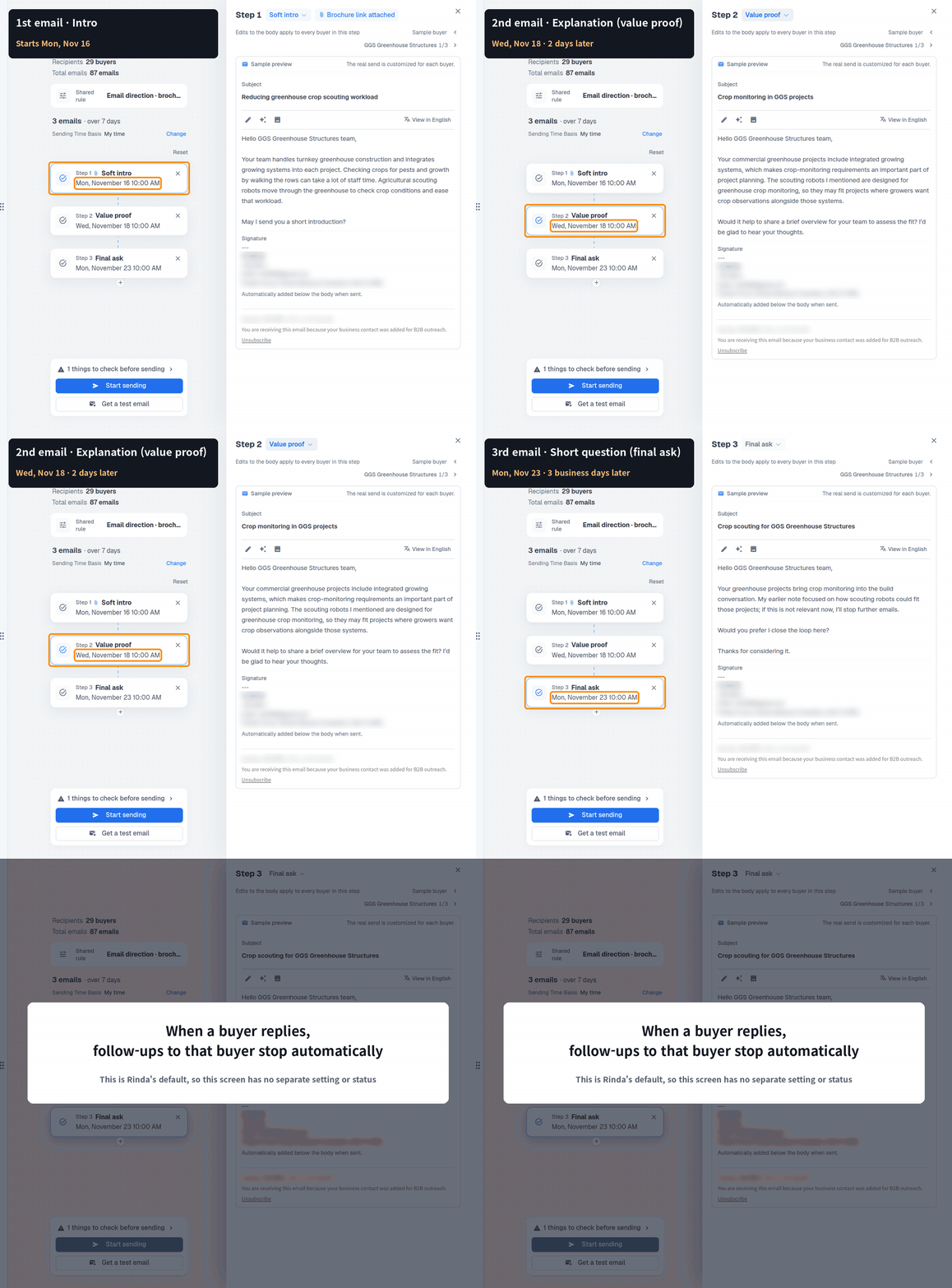
A: Normally, we send a sequence of three emails: the initial cold email followed by a second and third touchpoint. If a buyer replies, the follow-ups stop automatically, and subsequent emails are sent only to those who haven't responded. Incoming replies are classified into positive, negative, or auto-reply, allowing the representative to take over the conversation directly from there.
To avoid recipient fatigue, we usually wait 2 to 3 days for the first follow-up, and then stretch it to 3 to 4 days for the next. However, if you are on a tight schedule, shortening the interval to once every two days is perfectly fine.
I usually set the campaign to send on Tuesdays and Thursdays. Remember to send follow-ups as replies within the same email thread rather than starting a new email. Include a case study or metrics in the second email, and a single, quick question in the third. Lastly, wrap things up with something like, 'If you're not interested, I won't reach out again.'
A Word from Chanwoo
Lately, everyone on our team is using Rinda. We also frequently refer to Rinda's guides and blog posts when writing reports. Since it finds buyers and sends cold emails automatically, it fit our workflow perfectly.
A Word from Dongyeon
Our CEO, a KAIST graduate, also felt incredibly lost when trying to find and contact buyers one by one during his own business venture. Rinda was developed after he saw a path forward by leveraging AI for sales. Industrial goods in particular yield lower reply rates and have longer sales cycles than consumer goods. However, once you get that first response, the company—which knows the product best—can directly present its strengths, paving a smoother path toward closing the contract.
Even industrial companies with limited manpower can kickstart sales to their first buyers using targeted industry keywords in the destination country and a warmed-up domain. Rinda is here to help companies busy with product development focus entirely on conversations with interested buyers.
Automate Your Overseas Buyer Discovery Today!Start for Free →Want export insights in your inbox?
We'll send one email summarizing new posts from our blog and resource library.