Why Japanese B2B Buyers Reply to 1:1 Emails Over $100k Agency PR
Fancy global PR agencies and media coverage won't open the doors of conservative Japanese B2B buyers. Discover why personalized 1:1 targeted outbound email is the true key to initial export success, backed by real-world data.

Why Japanese B2B Buyers Reply to 1:1 Emails Over $100k Agency PR
Are you about to sign a contract with a global PR agency worth tens of thousands or even hundreds of thousands of dollars to find Japanese buyers? Under pressure from leadership and rushed to enter the market, you might expect a single glossy article to solve all your problems. If so, put down your pen for a moment and read this article to the end.
When our team at Grinda AI first started helping exporters build their initial sales pipelines, we also thought that making a grand, well-funded debut might be the fastest route. However, the reality was different. After analyzing buyer acquisition data from over 200 exporting companies, our conclusion was crystal clear.
In the Japanese B2B sales landscape, local buyers respond far more actively and positively to personalized 1:1 cold emails that pinpoint their specific operational pain points than to flashy, broad-audience mass media articles. What happens if you ignore this and burn your budget only on superficial brand awareness? Not only will you waste tens of thousands of dollars, but you will also lose the precious golden time of early-stage market entry to refine your product-market fit.
Why Doesn't a Flashy Press Release About Your Tokyo Entry Lead to Japanese B2B Sales Meetings?
Recently, global B2B marketing agencies have been flocking to Korea, claiming to help companies enter the Japanese and broader Asian markets. For instance, on June 24, 2023, the prominent global agency AIM B2B opened an office in Gangnam to begin full-scale operations (Source: CIO.com). They aggressively propose "localized integrated marketing" and glossy PR packages targeting the explosive demand for digital transformation (DX) in Japanese industries from 2024 onward.
For early-stage companies lacking capital, these package proposals are tempting shortcuts. However, you must not underestimate the highly conservative verification culture unique to large Japanese corporations, which our team has witnessed firsthand on the ground. While Japan outwardly champions digital transformation and open innovation, internally, they still maintain a rigorous, document-heavy decision-making system that tests the waters multiple times before moving forward.
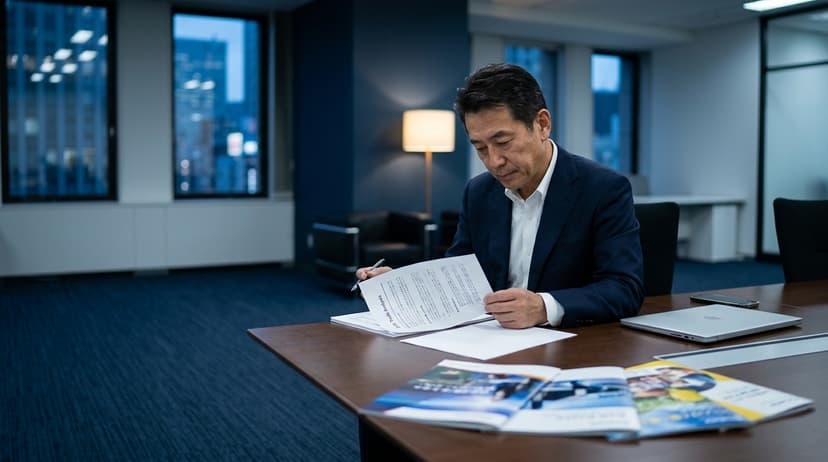
Japanese companies do not open their wallets based on media spotlights or flashy presentations at massive conferences. They buy based on thoroughly drafted internal proposal documents (ringisho). It doesn't matter if your company's article is featured on the front page of a leading local media outlet as an innovative business.
If there is no concrete, written evidence on a buyer's desk proving "how this Korean solution resolves the bottleneck our team is experiencing, and how it minimizes the risks of adoption," it is incredibly difficult to secure even a first meeting. While PR can build light 'awareness' in the market, it can never bypass the heavy barrier of 'trust validation' that lies at the core of B2B business. The weapon for a buyer's internal proposal is not a news article, but a sharp message containing exact specifications, references, and problem-solving capabilities.
The "Outsourcing Trap": Throwing Away Early Buyer Feedback with Paid Agencies
When first entering a foreign market, everyone feels immense anxiety due to language barriers and a lack of local networks. It's easy to fall into the temptation of outsourcing the entire early sales and buyer acquisition process to an agency, thinking, "The experts will handle it."
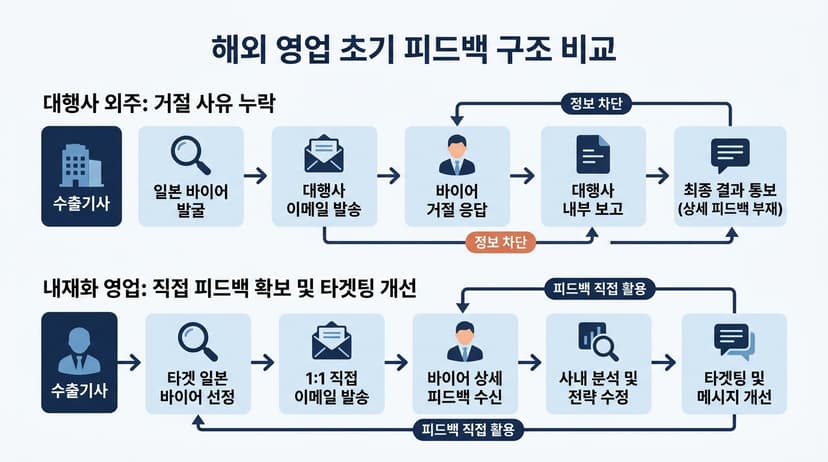
Frankly speaking, quite a few of our clients also paid high fees to outsource their sales in their early stages due to this vague fear. However, we learned the hard way that handing over the very first step of Japanese buyer acquisition to an external agency is equivalent to paying premium prices to throw your most valuable asset—"survival data"—into the trash.
Have you ever looked raw, cold rejection in the face when an early buyer responds to a cold email or proposal? In B2B export sales operations, these rejections are pure gold. When an agency steps in to sell on your behalf, this vital feedback loop is broken. What you get at the end of the month is often just a vague, generalized report saying something like, "Lead conversion rates were low due to the conservative nature of the local market," without any real cause or analysis.
Was the price too high compared to competitors? Did they hesitate due to local regulations or specific security requirements? Or did the decision-maker leave the company, making the timing wrong? This raw, authentic feedback—which is essential for fine-tuning your product and target audience—evaporates into thin air through the agency's filter. At a critical juncture when you should be sharpening your target focus and adjusting your value proposition, you end up breaking the compass that could guide your way.
Invest in "Cold Email Outbound" Instead of Media Exposure
So, what is the key to breaking through the frustratingly conservative "introduction" culture of the Japanese business landscape? After analyzing data from countless exporting companies, our team at Grinda AI has a firm answer. Large-scale PR or vague marketing campaigns aimed at an unspecified audience are never the solution.
Instead, we strongly recommend a "cold email outbound" strategy: pinpointing the actual decision-makers experiencing the problem within target companies and building 1:1 trust with messages tailored to their perspective.
"We have no local network or brand recognition—will a Japanese buyer even read a cold email from Korea?" We also had moments of doubt about whether this approach was too reckless at first. However, there are absolutely companies that successfully open the doors of large Japanese corporations with nothing but thoroughly planned and personalized cold email outbound strategies, completely bypassing the need for brand fame.
The customer case studies featured on the Rinda landing page clearly prove this. Take the case of Company S, a LiDAR sensor company dealing with cutting-edge tech. Instead of spending tens of thousands of dollars on a PR budget, they focused directly on building a precise list of target buyers who had the capacity to adopt their technology. They faced numerous rejections head-on, absorbed the feedback, and refined their messaging. As a result, despite being an early-stage company with no brand recognition, they successfully secured strong adoption intent from two global mass-production manufacturers and are now deeply negotiating PoC (Proof of Concept) specifications with one of them.
That’s not all. The achievements of Company L (a Korean language education platform) and Company R (an automotive fuel additive company) are equally remarkable. They didn't try to appeal to a broad local audience. Instead, they precisely targeted key decision-makers who immediately needed their product, securing major Japanese B2B partnerships and product evaluation opportunities on the spot.
None of these results were achieved by relying on million-dollar PR packages or the brand power of famous agencies. They are the direct, tangible outcomes of "personalized 1:1 messages" built on field data, narrowing down targets and directly addressing the buyer's operational pain points.
First Steps in Global Cold Emailing: Saving Costs and Closing Real Deals
In the early stages of exporting, the first step in global cold emailing to save costs and close real business deals doesn't start with a grandiose strategy. Before signing a contract for a $100k agency proposal, the action plan you should execute as a practitioner this coming Monday morning is very clear and simple.
Right now, list 100 key target decision-makers in Japan who are likely desperate for your product's solution. Research what their roles are and what projects their departments have recently been working on. Then, send them a personalized, 1:1 validation cold email that directly addresses the daily business challenges they face.

A word of caution: this is not about mindlessly blasting generic spam emails translated roughly into Japanese. That approach only damages your company's credibility.
Leverage the power of modern AI technology. However, technology itself should not be the goal. AI should serve as an excellent assistant—helping you monitor recent trends of your target decision-maker's company, understand the context hidden in news articles or corporate info, and logically connect "why this company needs our product right now."
Use AI as a lever to carefully craft a sophisticated proposal that perfectly fits the local business context. Ultimately, technology is just a tool to instill trust so that when the buyer opens the email, they think, "How does this Korean company understand our team's internal situation so deeply?"
These first 100 cold email attempts—where you directly face rejection and adapt to feedback—will accelerate your successful Japanese buyer acquisition far faster and more reliably than a year's worth of vague, thick reports from an agency.
Written by · Rinda Export Sales Research Team (Global Buyer Acquisition & Export Sales Automation Research Editors)
Our team at Grinda AI shares insights built on actual global buyer acquisition pipeline data from over 200 Korean exporters, along with observations from within the Rinda platform. We passionately brainstorm and curate practical strategies and checklists that export decision-makers can implement immediately in their daily operations.
Feeling lost and overwhelmed about taking your first steps in the Japanese market without a local network or introduction channels? If so, take a look at the data-backed buyer acquisition strategies that our Grinda AI team has refined through countless failures and iterations alongside our clients since our founding.
Rinda (an AI platform that automates global buyer acquisition and sales for exporters), which helps you pinpoint target decision-makers ready to buy your product and write context-aware messages, and the Grinda AI team, who obsessively tackle this single problem every day, will be your reliable, professional partner in building your early sales pipeline.
Frequently Asked Questions (FAQ)
Q. I heard Japanese buyers rarely read cold emails from foreign companies. Does it really work? A. If it's a generic spam email blasting corporate brochures to an unspecified audience, it will absolutely be ignored. In Japan's conservative business environment, such emails are considered unworthy of opening. However, a highly targeted "cold email outbound" that pinpoints the operational challenges of the target company and provides clear evidence of how your solution solves them is on an entirely different level. Even within Japan's strict validation culture, this method is the most powerful and practical weapon to capture a buyer's attention and earn solid trust. In fact, our data shows that a well-crafted email yields a significantly higher meeting conversion rate than blind PR.
Q. We don't have a native Japanese speaker on our team. Can we still run B2B sales in Japan ourselves? A. Yes! To put it simply, it is a highly winnable battle, and many early-stage companies are already doing it successfully. What we've observed in the field is that in the early stages of global sales, a deep understanding of your product's technical advantages and the fundamental pain points of the target industry is a hundred times more important than perfect, fluent Japanese. Smooth business nuances and polite expressions in written communication can easily be optimized to fit the business context using modern AI technology. Rather than giving up control of your sales to external parties out of fear of language barriers, we highly recommend that your internal team—who understands your product best—take the lead, face the market directly, and sharpen your targeting.
Related resources
You don't have to figure export out alone
From finding buyers to closing deals, Rinda is with you. Book a free 30-minute chat to see how we can help.