
A Fatal Mistake by 68% of Global B2B: What Happens the Moment You Copy Buyer Price Lists into ChatGPT
68% of global B2B companies worry about trade secret leaks when using cloud AI. Discover how 'Local Data Capture' technology automates CRM entries and understands your PC workflow without exposing confidential data.

A Fatal Mistake by 68% of Global B2B: What Happens the Moment You Copy Buyer Price Lists into ChatGPT\n\n## Executive Summary\n\n- The moment you copy sensitive price negotiations into a cloud AI like ChatGPT, your core pricing policies and exclusive contract terms leak to external servers, creating a fatal buyer price leak risk for your B2B sales AI security.\n- According to a recent Gartner report, 68% of global B2B companies are concerned about confidential data exposure when using cloud AI.\n- To capture workflow context and automate local AI CRM entries without risk of leaks, we highly recommend adopting 'Local Data Capture' technology that securely records actions offline.\n\nJust moments ago, your Zoom meeting with an American buyer you've been courting for six months finally wrapped up. The buyer reacted positively, proposing to adjust exclusive unit prices and delivery terms. Thrilled with the progress, you copy the meeting transcript and absentmindedly paste it into ChatGPT: "Summarize these minutes and write a professional follow-up email in English that the buyer will love."\n\nThis three-second shortcut might actually be your company's most critical security breach.\n\nThe cost margins, HS code classification expertise, and country-specific discount rates that export managers handle daily are the lifeblood of your company. Yet, simply for the sake of convenience, these massive trade secrets are flowing unchecked into public cloud servers.\n\n## Can You Automate Safely Without Buyer Price Leaks? Cloud AI vs. Local AI CRM\n\nIn global B2B sales, buyer trust and data security directly determine the success of a deal. Especially in markets with strict security regulations like Europe or the US, buyers scrutinize how vendors manage data under a microscope. Ultimately, cloud-based AI sales tools can act as a ticking time bomb, leaking your core trade secrets the more you use them.\n\nHowever, a local AI CRM based on "Local Data Capture" takes an entirely different approach. The AI never transmits even a single byte of data to an external server. It captures and processes screen and audio context quietly, running entirely within the user's local PC.\n\n| Category | Data Storage Location | Security Risk | CRM Automation Level |\n| --- | --- | --- | --- |\n| Manual Process | Intranet or Local PC | Low (Minimal leak risk) | Low (Manual data entry by staff) |\n| Cloud AI (e.g., ChatGPT) | External Vendor Servers (Overseas) | Very High (Risk of confidential data exposure & training) | Medium (Summarizes, but requires manual copy-pasting) |\n| Local-Only AI (Data Capture) | User's Local PC | Low (External transmission fundamentally blocked) | High (Shadows workflow and automates entry) |\n\nAs shown in the table above, Local Data Capture combines the robust B2B sales AI security of offline manual workflows with the overwhelming efficiency of cloud AI.\n\nIf you are an export sales manager, we highly recommend reviewing this three-step Export Business Security Guide with your team today:\n1. Are you uploading entire documents containing NDA (Non-Disclosure Agreement) terms with buyers into general-purpose AIs?\n2. Are you anonymizing the buyer's real name, company name, and exact prices when drafting email templates?\n3. Are you processing data on external websites before entering it into your internal CRM?\n\n \n\n## The Core of On-Device AI Sales: 'Local Data Capture' Mimicking Your Work Without Prompts\n\nTrue workflow automation isn't achieved by forcing employees to learn complex "AI prompting techniques." Instead, it starts with "shadowing" technology, where the AI quietly observes and mimics how an employee actually works.\n\nThis essence becomes clear when looking at the case of Louis, a developer who has been exploring personal CRMs and AI second brains since 2020. He drew significant attention on Hacker News by releasing early GPT-2 fine-tuned models and Ava, one of the first Obsidian AI plugins. He successfully proved the immense power of on-device AI sales, where the system automatically reads background workflows without requiring manual keyboard commands.\n\nOf course, from an operational standpoint, you might worry: "Will my old work laptop handle this?" Running screen and audio recording all day could overheat the CPU or drain the battery. Fortunately, modern local AI models have shed significant weight through on-device optimization, allowing them to run seamlessly even on standard business laptops.\n\nTheir multilingual processing capabilities are even more impressive. According to the latest AI trend reports, the accuracy of real-time Optical Character Recognition (OCR) and Speech-to-Text (STT) for complex languages has reached production-grade quality. Even a complex invoice containing kanji or localized terms shown by an overseas buyer during a Zoom meeting is immediately captured and cleanly converted into text.\n\nAction Item: To test local AI compatibility on your PC, open Task Manager (Windows) or Activity Monitor (Mac) and check if you have at least 4GB of free RAM. If you have this resource available, you can easily run a lightweight shadowing AI.\n\n
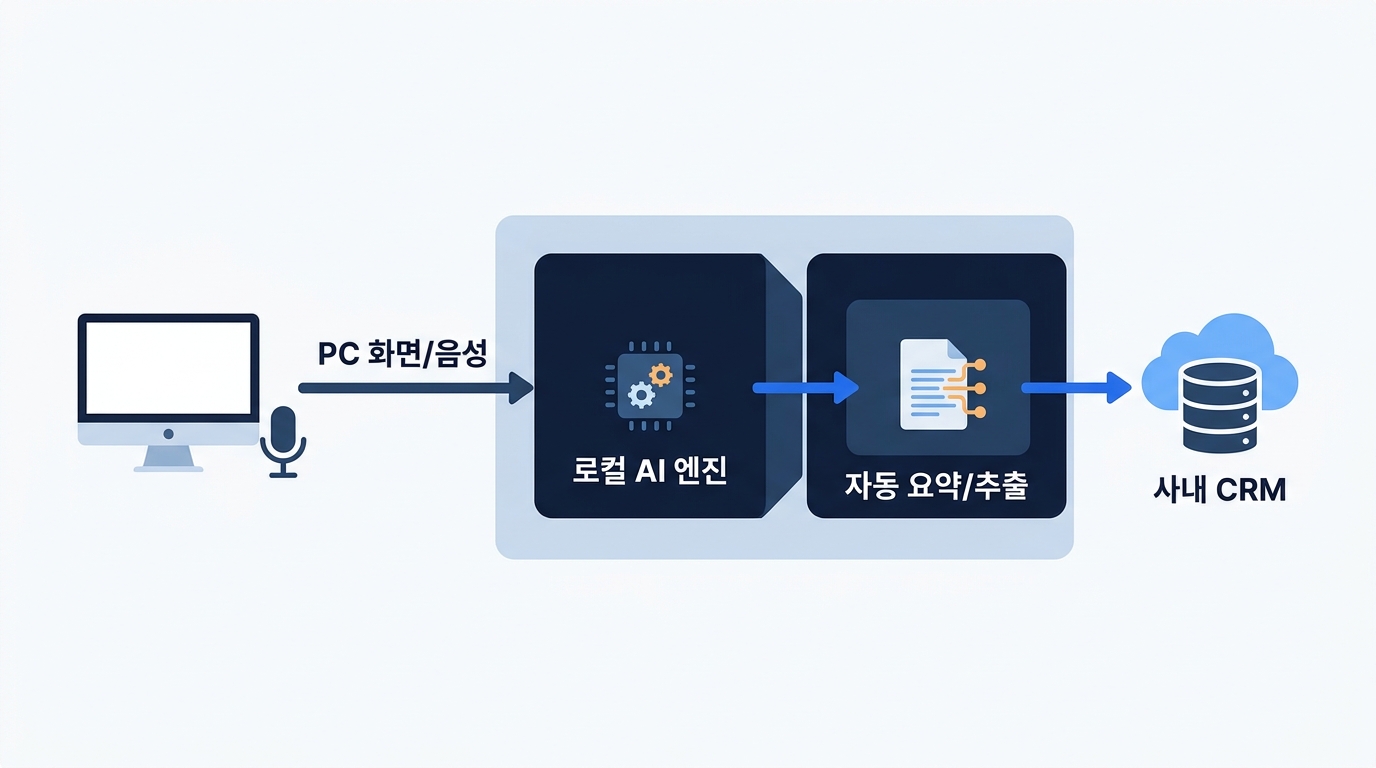 \n\n## The Magic of Auto-Logging with Local AI CRM Instantly After a Meeting Ends\n\nSo, what specific changes happen when this Local Data Capture technology is deployed in real-world on-device AI sales environments?\n\nAccording to our observations, companies that adopted this technology literally "erased" the time wasted on administrative tasks after buyer meetings. While you negotiate intensely on Zoom or Teams, the local AI quietly runs in the background, carefully recording the context. The moment you close the meeting window, a draft follow-up email incorporating the buyer's requested specifications, delivery dates, and quote figures pops up on your screen. The empty fields in your company CRM are filled out instantly.\n\nThe applications go far beyond meetings. The tedious process of a veteran manager sorting business cards from global trade shows into Excel sheets, or looking up customs sites to fill out HS codes, is also captured. These recorded workflows can be automatically transformed into standard operating procedures (SOPs) that even new hires can execute immediately.\n\n3-Step Post-Buyer Meeting Automation Workflow Template Using Local AI\n1. Auto-Summary Trigger: Review the key discussion points and action items generated by the local AI immediately after the meeting ends.\n2. One-Click Draft Send: Confirm and send the follow-up email draft that accurately reflects the captured pricing and delivery terms.\n3. CRM Synchronization: Automatically update the relevant buyer card in Salesforce or HubSpot via APIs using the securely processed local data.\n\nAmazement lies in the fact that throughout this entire process, not a single transmission is made to an external cloud. The core technologies and confidential pricing info your company worked tirelessly to build are locked down tight, completely preventing buyer price leaks.\n\n> Author · Rinda Export Sales Research Team (Global Buyer Discovery & Export Sales Automation Research Editor)\n>\n> We compile actionable strategies and checklists based on pipeline data from over 200 Korean exporters and internal observations of the Rinda platform.\n\nDo not forget: carelessly using cloud-based AI sales tools can become a conduit for leaking your company's core trade secrets. In a highly security-conscious global B2B market, what if you want to comply with a strict export business security guide and enjoy flawless sales automation without worrying about a single leak? We recommend building a secure local AI CRM environment with Rinda, the AI platform that handles everything from global buyer discovery to sales automation for exporters with strong B2B sales AI security. If you are curious about the bigger picture of how AI can transform your business, Grinda's solutions will also serve as your ultimate compass.\n\n## Frequently Asked Questions\n\nQ. Can this integrate with our existing CRM software (Salesforce, HubSpot, etc.)?\nA. Yes, absolutely. Local Data Capture simply avoids sending raw, sensitive data to external clouds. The securely extracted text outputs (summaries, field data) can be instantly transferred to your existing CRM via internal APIs. This approach delivers both ironclad security and flexible connectivity.\n\nQ. Since this is based on PC screen recording, won't employees mistake it for surveillance?\nA. This is a crucial question to address during adoption. The data captured by local AI is never sent to a central server or an administrator. It remains strictly within each individual employee's device. It operates solely to improve the respective employee's personal productivity and is automatically deleted on a set schedule, completely alleviating any concerns about privacy invasion.