
Why Japanese Buyers Reply More to 'Department' Emails Than 'Personal' Names—An Insight into Japanese B2B Collectivism
While expanding into the Japanese market, I discovered that the way I addressed my outbound cold emails had a massive impact on conversion rates. After closing a deal with a Tokyo trading company, a contact told me, 'I was surprised by your first email. Usually, foreign companies address individuals, but you used our department name, which felt professional.'
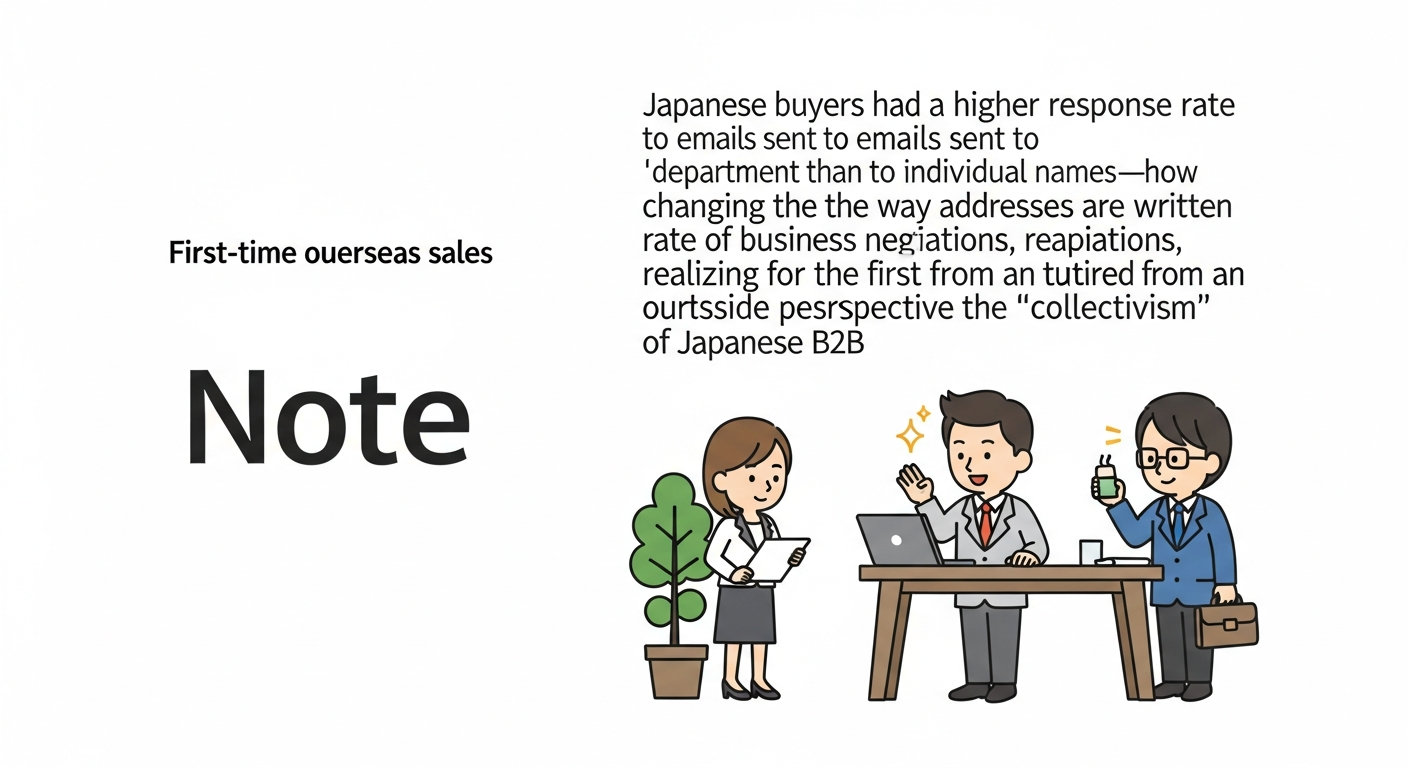
The 'Addressing' Law I Learned Expanding to Japan: Why Buyers Reply to Departments, Not Individuals
While expanding into the Japanese market, I realized that the way I addressed my outbound cold emails significantly swayed my conversion rates. Following a successful deal with a Tokyo trading firm, the representative shared an insightful comment during small talk:
"Honestly, I was surprised when I received your first email. Most foreign companies address us as 'Mr./Ms. [Name],' but your company addressed the 'Sales Department.' It gave me the impression that you were... well, professional."
That remark has stuck with me ever since.
It has been about a year and a half since we scaled our outbound sales for Japan. Initially, I thought searching for personal names and using "Dear Mr./Ms. [Name]" was the most polite way to reach out. But tracking the reply rates yielded an unexpected result.
The Lesson from Cold Emails: Addressing Departments vs. Individuals
First, a disclaimer: this wasn't a massive, rigorous A/B test. It is a trend I noticed while managing Japanese outbound campaigns—our company's internal findings. Please take this as a practical experience, not an academic study.
We tested two versions of the same email sent to Japanese firms of similar scale and industry:
- Pattern A: "Dear Mr. Tanaka, [Company Name]" (Personal name)
- Pattern B: "To the Purchasing Department, [Company Name]" (Department name)
Honestly, I initially thought the personal approach would be more polite and therefore yield higher response rates.
But the reality was different.
Pattern B had a significantly higher response rate. (Exact figures are internal data, but the conversion rate was about 1.5 times higher.)
Confused, I asked several Japanese buyers and traders why. The answers I received were eye-opening for someone looking in from the outside.
'Emails to Individuals Require Personal Responsibility'
One veteran buyer in his 60s explained it this way:
"When I get an email addressed to me personally, I feel like I'm the one who has to handle it. But if it's addressed to the department, I can pass it on. It's much easier to deal with."
It clicked instantly.
In Japanese B2B organizations, decision-making is rarely left to a single individual. The ringi (internal approval process) is deeply ingrained, and employees are rarely empowered to make unilateral decisions. When I addressed "Mr. Tanaka," he felt the psychological pressure of "do I have the authority to handle this alone?"
On the other hand, "To the Purchasing Department" treats the email as an organizational matter. It creates a consensus that "someone needs to handle this" or "it can be forwarded to a superior."
From an outsider's perspective, this might seem inefficient. To be honest, I thought so too at first.
But looking closer, this functions as the organization’s "risk distribution." Decisions aren't centralized in a single person; the organization acts as a unit. That culture permeates even the way emails are addressed.
The Deeper Meaning of the Term 'Onchu' (御中)
When I researched the Japanese suffix "Onchu," I was surprised. It’s not just a polite way to address a company; it carries the nuance of addressing "everyone within the organization."
It is more concise than saying "To all employees of [Company Name]," yet it conveys that the message is intended for the organization as a whole.
I don't think that nomenclature evolved by accident. It is a form of communication for collective bodies that Japanese business culture has refined over a long period.
Conversely, my initial use of "Mr. Tanaka" could be interpreted in the Japanese context as, "You are responsible for this matter personally." That might have been the hurdle raising the barrier to a response.
B2B 'Collectivism': Not a Weakness, But a Strength
Before entering the Japanese market, I viewed the consensus-based decision process as a "barrier that wastes time."
I’ll be honest: after experiencing long waits of one or two months for ringi approval, I have wished they were more agile.
But now, I see it differently.
The reason Japanese companies take time to reach a decision is rooted in their intense reliability: once a decision is made, the entire organization honors that commitment.
Their follow-through after approval is remarkably meticulous. Meeting deadlines, sticking to specifications, and maintaining constant communication—these only function because of the "work as an organization" culture.
In contrast, cultures that rely on rapid individual decisions might be fast, but they carry the risk of relationships being reset the moment that individual changes roles or leaves.
Neither is better or worse, but Japanese "collectivism" offers a stability in long-term trade that you only recognize when you see it from the outside.
How to Write Emails: Respecting the 'Collectivist' Mindset
It wasn't just the salutation that impacted response rates. Here are a few points on communicating with a focus on this collective nature:
① 'To Whom It May Concern' (ご担当者様) works surprisingly well
When you don't know the specific name, this expression implies "I am not targeting you personally, but rather the person in charge of this role," lowering the psychological hurdle for the recipient.
② Don't isolate a single decision-maker
Phrasing like "I want to propose this directly to the CEO" can be counter-productive. Using "I would be grateful if you could share this with the relevant department for their consideration" fits much better with the ringi culture.
③ Shift from 'I'm sending files' to 'Please consider this once you've reviewed it'
Initially, I thought this was wordy. But including "once you've reviewed it" shows you aren't rushing them and allows them the space to review it collectively. It actually led to higher response rates.
This isn't about "Japanese honorifics"; it's about the structural respect for an entity that acts as an organization.
The Hidden Logic of Japanese B2B Observed from Abroad
In summary, I believe this is the core:
Japanese B2B communication is designed as "organization-to-organization," not "person-to-person."
I didn't realize this by studying Japanese; I realized it by sending dozens of emails and meeting numerous representatives.
The fact that "department" addresses get more replies is just a symptom of that reality.
For those entering the Japanese market, the practical implication is to shift from the mindset of "persuading an individual" to "providing information that helps an organization move forward."
AI-powered sales automation is accelerating globally, but no matter how advanced the technology gets, it will fail unless you understand these cultural designs. Understanding the "decision-making mechanism" of your partner is even more critical than the tool itself.
What about you?
If you have had experiences with approaching Japanese companies—what worked, what didn't—please let me know in the comments. I'm sure there are many perspectives I'm still missing as an outsider.
If you found this article helpful, please show your support with a "Like"!
Get a free consultation for your tailored overseas sales plan.
Start building your global bridge with Rinda today! Rinda | B2B Global Sales AI Agent for International Expansion For inquiries, feel free to reach out via LINE. Add LINE friend
Frequently Asked Questions (Q&A)
Q1. Even if I know the contact person's name, is it better to address the department?
A. Not necessarily. If you know the name, the best balance is to combine them, like "[Company Name], Purchasing Department, Mr. Tanaka." This avoids putting the burden solely on one person while showing proper respect, helping both reply rates and brand image.
Q2. Are there other points to consider regarding 'collectivism' during outbound sales?
A. Yes. For follow-up emails after a meeting, adding, "I would be grateful if you could share this with your relevant departments" helps the internal approval process. Making it easy for the organization to move is key to closing deals.
Q3. Besides cold emails, what other sales methods account for collective decision-making?
A. Participation in trade shows or industry associations is highly effective. Because Japanese companies value "organizational credibility," being present in places that prove your status as a legitimate partner makes it much easier for your internal contact to push a proposal through the ringi system.
#GlobalSales #JapaneseMarket #B2Bsales #BuyerSourcing #ExportMarketing #JapanKoreaBusiness #ColdEmail #OutboundSales #MarketExpansion #SalesAutomation #JapaneseBusinessCulture #SMEExport