Why ASML, with its $220M Equipment Monopoly, Outsources Core Components
Competing with global enterprise buyers purely on specs and price has clear limits. Learn the B2B sales strategy of capturing a critical niche within a buyer's supply chain—where 'the entire process halts without our tech'—and proposing a supply chain partnership, just like ASML.
Why ASML, with its $220M Equipment Monopoly, Outsources Core Components
Striving to be number one in the finished product market is often a wild goose chase in global B2B export sales. Instead, a much smarter choice is to penetrate the leader's production line and become a single "chokepoint"—where the process simply cannot run without your component. This is especially true when you consider long-term survival rates and profit margins. Are you still suffering from buyer price cuts (cost-cut) pressure today? If you are an export manager tired of creating meaningless spec comparison sheets, we highly recommend paying attention to this paradoxical global sales strategy.
Selling a $220 Million Machine and Not Making the Core Components?
Breaking Free from the Illusion of In-House Production
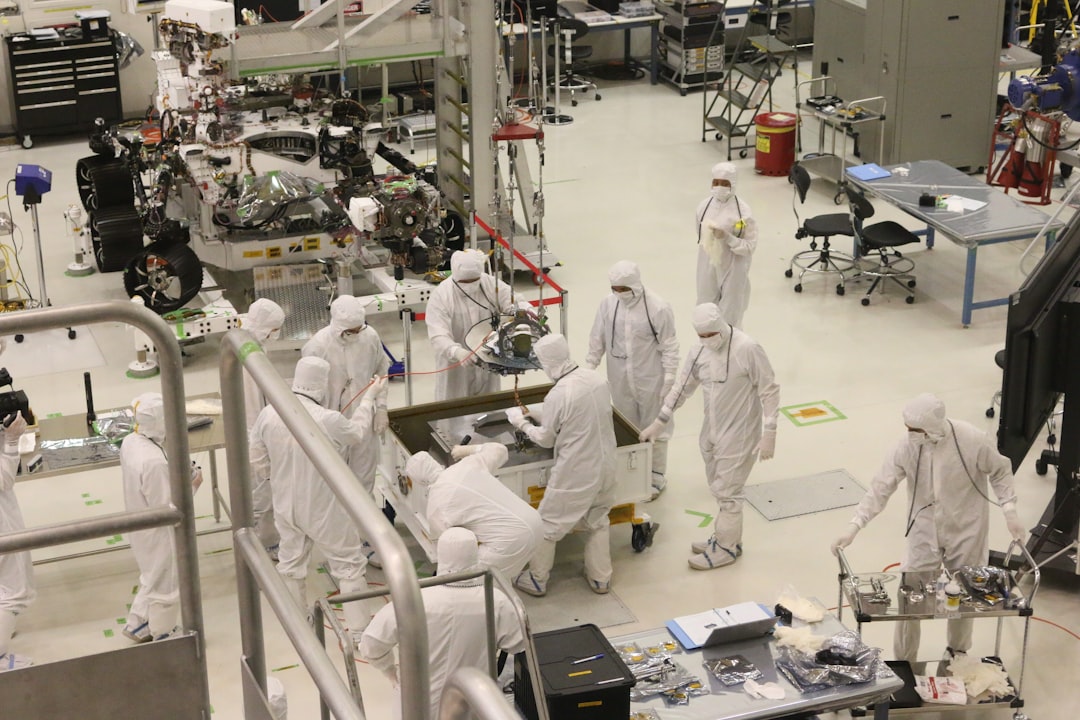
The case of ASML, the Dutch company that monopolizes the production of Extreme Ultraviolet (EUV) lithography systems—the most complex machines in the world—offers us a profound lesson. A single EUV machine costs a staggering $220 million USD (approx. 300 billion KRW). Surprisingly, however, ASML does not manufacture most of its core components in-house. An analysis by the IT publication Works in Progress makes the reason clear. ASML's EUV system is broken down into about 100,000 components, supported by a dense network of hundreds of specialized global suppliers. They have completely shattered the illusion that everything must be built in-house.
Ecosystem Lock-in Proven by Zeiss and Trumpf
ASML's true monopoly power does not come from manufacturing every part themselves. It stems from their ability to "orchestrate" and lock in irreplaceable, ultra-precision suppliers into their ecosystem. Prime examples include German optics giant Zeiss and laser manufacturer Trumpf. In particular, the EUV mirrors supplied by Zeiss are polished to a precision of 0.1 nanometers—the thickness of just a few atoms. This tacit knowledge and the mutually dependent ecosystem built over decades cannot be replicated overnight simply by pouring in capital. As seen in McKinsey's analysis of global supply chain dependencies, a supply chain deeply rooted in a specific technology ecosystem becomes a massive barrier to entry in itself.
The Ultimate Global Sales Strategy to Defend Against Buyer Price Cuts: The 'Chokepoint'
Targeting an Ultra-Precision Niche Where Production Stops Without You
To capture the hearts of global enterprise buyers, SME exporters must target this exact spot. Simply shouting, "Our product is 5% cheaper and has better specs!" is dangerous. It's a positioning frame that will easily crumble under competition from emerging manufacturing hubs. Instead, we recommend relentlessly analyzing the buyer's production line and service structure, which is the true key to successful B2B export sales. Find a niche-down area where "everything stops without this component" and dominate it.
 An intuitive 3D graphic scene inside a massive factory production line where a single, small, and precise component glows brightly, connecting the entire manufacturing process.
Proposing Interdependence Instead of Spec Sheets
Before pushing a spec comparison sheet, you need to objectively assess whether your product is a mere commodity to the buyer or an essential chokepoint partner. We have prepared a "Chokepoint Index Checklist for Your Product" that you can use in practice right away.
- Switching Risk: If the buyer switches your product to another supplier, does recalibrating the existing process or system take more than a month of time and cost?
- Process Impact: If a defect occurs in your product, does it cause critical delays in the buyer's final product release?
- Irreplaceability: Are there fewer than three competitors in the global market offering the same level of precision and stability as you?
Did you confidently answer "Yes" to two or more of these three questions? If so, you have earned the right to wield the powerful weapon of "stability" instead of price at the negotiation table.
The "Second Source" Opportunity Created by US-China Tensions
Single Point of Failure (SPOF) Risk and Supply Chain Diversification
As of 2026, geopolitical conflicts, including the US-China semiconductor hegemony war, have intensified, completely flipping the sourcing strategies of global enterprises upside down. This shift is clearly evident in Gartner's recent supply chain resilience analysis. Abandoning the single-source structures of the past that chased only efficiency, companies are now risking everything on supply chain diversification (multi-sourcing). This is because they have learned the hard way about the risk of a "Single Point of Failure (SPOF)" where a single supply chain is disrupted or paralyzed.
How to Prove We are the Perfect Alternative
This defensive mindset among buyers presents an incredible opportunity for exporting companies. There is no need to try and immediately kick out the incumbent primary vendor. Approaching them by saying, "We are a reliable second source and a complementary partner that can perfectly diversify your risk," yields a much higher success rate in global sales.
Turning Unanswered Cold Emails into 'Supply Chain Partnership' Offers that Win International Buyers
Shifting the Language from Vendor to Partner
Once you have compiled a list of target buyers who fit your profile, it is time to change the language of your outbound sales messages. For effective finding of international buyers, forget about passively dropping product catalogs. We highly recommend completely restructuring your cold emails around the theme of building a resilient supply chain defense for the buyer.
 A natural business scene where an overseas buyer in an office nods with interest while reading a partnership proposal email on a laptop screen.
The Outbound Template to Land Your First Meeting
Here is a supply chain diversification proposal template you can copy and use right away.
Subject: Supply Chain Risk Diversification Proposal for [Buyer Company]'s [Key Process/Product]
Dear [Contact Name],
We have observed that many companies are currently prioritizing the stable supply of [Key Component] due to recent geopolitical factors in Asia.
We are a specialized manufacturer of [Your Product Line] based in South Korea. While we understand you likely have an excellent primary supplier in place, we would like to propose evaluating us as a highly reliable 'second source' to preemptively mitigate unexpected bottleneck risks.
Our components guarantee [one key spec, e.g., 0.1nm-level precision processing], allowing for immediate testing without requiring changes to your existing lines or specifications.
Would you be open to a brief 15-minute video call [this Thursday] to discuss supply chain risk mitigation strategies?
Targeting timing is just as crucial to success as the message itself. Looking at the data we have observed, we can find an interesting fact. Companies that sent their first follow-up within 48 hours of an exhibition or initial contact via a platform showed a noticeably higher response rate from overseas buyers compared to those who followed up 7 days later. (Of course, the exact impact of this may vary depending on your specific industry or the buyer's long-term purchasing decision-making structure.)
Author · RINDA Export Sales Research Team (Finding International Buyers & Export Sales Automation Research Editor)
Based on pipeline data of finding international buyers from 200+ Korean exporters and internal observations of the RINDA platform, we edit strategies and checklists that can be applied immediately in export practice.
To successfully execute such a precise supply chain partnership targeting, you ultimately need an environment that supports quick validation of and access to massive buyer databases. On its official website, RINDA showcases a global buyer database of "800 million+ buyers across 200+ countries," providing detailed buyer distribution maps by country. (Note that the reference figures may vary slightly, with some promotional materials or feature comparison charts showing numbers like 85,000+ or 500 million+ depending on the context.)
Tired of the strict price pressure from buyers and the territorial behavior of incumbent suppliers? Stop wasting valuable time on passive research. We highly recommend putting your own ecosystem lock-in global sales strategy into action right now with RINDA, the AI platform that seamlessly automates everything from finding international buyers to export sales.
- RINDA: https://rinda.ai/?utm_source=rinda_blog&utm_medium=organic&utm_content=asml_3_100
- 그린다: https://grinda.ai/?utm_source=rinda_blog&utm_medium=organic&utm_content=asml_3_100
FAQ
Q. What if a buyer rejects a second-source proposal, citing an exclusive contract with their existing vendor? Do not demand high-volume shipments or press them to replace their primary line right away. Instead, we recommend casually proposing a small-scale pilot test (POC) for their R&D department or new product prototype development line. Rather than trying to replace the existing supplier entirely from day one, your goal should be to position yourself as a reliable "insurance policy" for the buyer.
Q. I tried the Chokepoint Checklist, but our company exports commodity products. Is this strategy still effective? For commodities, you need to shift your perspective slightly. Instead of focusing on the product's specifications, create a "service-level chokepoint" through aspects like "delivery reliability," "custom packaging options," or "dedicated CS response times." Making the buyer's procurement manager feel, "Working with this company gives me the most peace of mind and the least risk," is in itself an excellent partnership lock-in strategy.
"Tired of buyer price cuts pressure? Don't try to beat the market leader's specs; instead, become an irreplaceable 'chokepoint' in their supply chain. This is the real secret behind ASML's dominance in the $220 million equipment market."